Ch. 16 - Reactions of Aldehydes and Ketones • More Reactions of Carboxylic Acid Derivatives
Bruice - Organic Chemistry 8th Edition
Bruice8th EditionOrganic ChemistryISBN: 9780135213711Not the one you use?Change textbook
Chapter 17, Problem 79b

Draw structures for A-D for each of the following:
b. Diagram showing the conversion of a carboxylic acid to an acid chloride with labeled reaction steps A-D.

Verified step by step guidance
1
Step 1: Analyze the starting compound, which is a ketone. The first reaction involves LiAlH4 followed by H2O. LiAlH4 is a strong reducing agent that reduces ketones to secondary alcohols. Therefore, Compound i will be the secondary alcohol corresponding to the reduction of the ketone group.
Step 2: The second reaction involves SOCl2 in pyridine. SOCl2 is commonly used to convert alcohols into alkyl chlorides via substitution. Thus, Compound ii will be the alkyl chloride formed from the secondary alcohol in Compound i.
Step 3: The third reaction involves the use of P(C6H5)3 and C4H9Li. This is indicative of a Wittig reaction, where the alkyl chloride (Compound ii) reacts to form a phosphonium ylide intermediate, which then reacts with a carbonyl compound to form an alkene. Compound iii will be the alkene formed.
Step 4: The final step involves the conversion of Compound iii into Compound iv. Based on the structure provided, Compound iv appears to be a ketone. This suggests that Compound iii undergoes oxidation to regenerate the ketone functional group.
Step 5: Draw the structures for each compound (A-D) based on the transformations described above. Ensure that the stereochemistry and connectivity are consistent with the reagents and reaction conditions provided.

Verified video answer for a similar problem:

This video solution was recommended by our tutors as helpful for the problem above.
Video duration:
3m
Was this helpful?

Key Concepts

Here are the essential concepts you must grasp in order to answer the question correctly.

Reduction Reactions

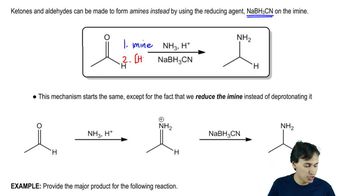
Reduction reactions involve the gain of electrons or the decrease in oxidation state by a molecule. In organic chemistry, this often refers to the conversion of carbonyl compounds (like aldehydes and ketones) to alcohols. The reaction shown in the image uses lithium aluminum hydride (LiAlH4), a strong reducing agent, to reduce a carboxylic acid to an alcohol, which is crucial for understanding the transformation of compounds in the reaction scheme.
Recommended video:
Guided course
07:12
Reductive Amination

Formation of Acid Chlorides

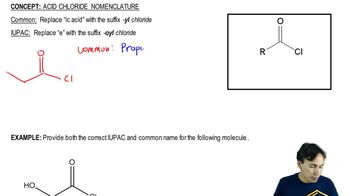
Acid chlorides are derived from carboxylic acids by replacing the hydroxyl (-OH) group with a chlorine atom. This transformation is typically achieved using reagents like thionyl chloride (SOCl2) in the presence of a base such as pyridine. Understanding this conversion is essential for recognizing how the reaction scheme progresses from a carboxylic acid to an acid chloride, which is an important intermediate in organic synthesis.
Recommended video:
Guided course
03:13
Acid Chloride Nomenclature

Grignard Reagents

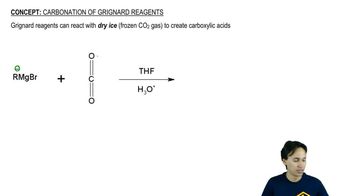
Grignard reagents are organomagnesium compounds that are highly reactive and used to form carbon-carbon bonds in organic synthesis. They are generated by reacting alkyl or aryl halides with magnesium metal. In the reaction scheme, the use of a Grignard reagent (C4H9Li) indicates a step where the acid chloride is reacted to form a new carbon chain, highlighting the importance of these reagents in building complex organic molecules.
Recommended video:
Guided course
02:12
Carbonation of Grignard Reagents