Ch. 16 - Reactions of Aldehydes and Ketones • More Reactions of Carboxylic Acid Derivatives
Bruice - Organic Chemistry 8th Edition
Bruice8th EditionOrganic ChemistryISBN: 9780135213711Not the one you use?Change textbook
Chapter 17, Problem 85a

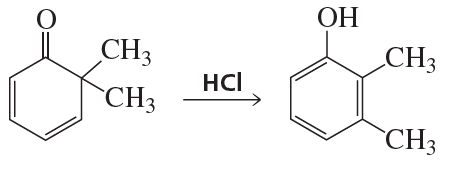
Propose a mechanism for each of the following reactions:
a. Chemical reaction diagram showing tautomerization with reactants and products labeled, including HCl as a catalyst.

Verified step by step guidance
1
Step 1: Analyze the starting material and reagent. The starting material is a ketone attached to a cyclohexane ring with a phenyl group and an ethyl group. The reagent is concentrated sulfuric acid (H₂SO₄), which acts as a strong acid and catalyst for protonation and rearrangement reactions.
Step 2: Protonation of the ketone group. The oxygen atom in the ketone is protonated by H₂SO₄, forming a positively charged oxonium ion. This increases the electrophilicity of the carbonyl carbon, making it susceptible to nucleophilic attack or rearrangement.
Step 3: Formation of a carbocation intermediate. The protonated ketone undergoes a rearrangement where the bond between the carbonyl carbon and the adjacent carbon breaks, leading to the formation of a carbocation at the benzylic position (the carbon attached to the phenyl group). This carbocation is stabilized by resonance with the phenyl ring.
Step 4: Rearrangement and aromaticity restoration. The carbocation undergoes a hydride shift or alkyl shift to form a more stable aromatic intermediate. This step restores the aromaticity of the benzene ring and positions the phenyl and ethyl groups appropriately.
Step 5: Deprotonation to form the final product. A water molecule or another base removes a proton from the hydroxyl group, resulting in the formation of the final product: a phenol derivative with the phenyl and ethyl groups attached to the aromatic ring.

Verified video answer for a similar problem:

This video solution was recommended by our tutors as helpful for the problem above.
Video duration:
6m
Was this helpful?

Key Concepts

Here are the essential concepts you must grasp in order to answer the question correctly.

Tautomerization

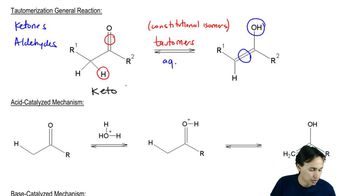
Tautomerization is a chemical reaction that involves the interconversion of two isomers, typically involving the migration of a hydrogen atom and a switch of a double bond. In organic chemistry, this often occurs between a keto form and an enol form. Understanding this concept is crucial for analyzing reactions where structural rearrangements take place, as seen in the provided reaction.
Recommended video:
Guided course
05:11
Tautomerization Mechanisms

Acid-Catalyzed Reactions

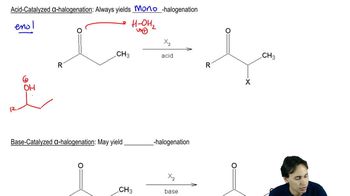
Acid-catalyzed reactions involve the use of an acid, such as sulfuric acid (H2SO4), to facilitate the transformation of reactants into products. The acid can protonate functional groups, making them more reactive and promoting rearrangements or eliminations. Recognizing the role of the acid in the mechanism is essential for predicting the outcome of the reaction shown.
Recommended video:
Guided course
03:09
Acid Catalyzed

Electrophilic Aromatic Substitution

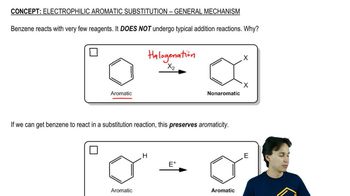
Electrophilic aromatic substitution (EAS) is a fundamental reaction in organic chemistry where an electrophile replaces a hydrogen atom on an aromatic ring. This process is significant in the context of the reaction, as the presence of the phenyl groups suggests that the aromatic system may be involved in stabilizing intermediates during tautomerization. Understanding EAS helps in predicting how substituents on the aromatic ring will influence the reaction pathway.
Recommended video: