Ch. 16 - Reactions of Aldehydes and Ketones • More Reactions of Carboxylic Acid Derivatives
Bruice - Organic Chemistry 8th Edition
Bruice8th EditionOrganic ChemistryISBN: 9780135213711Not the one you use?Change textbook
Chapter 17, Problem 62c

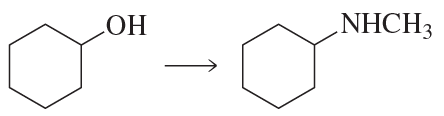
Show how each of the following compounds can be prepared, using the given starting material:
c. Chemical reaction showing the conversion of a cyclohexanol to a cyclohexylamine with an amine group.

Verified step by step guidance
1
Step 1: Analyze the starting material and the target compound. The starting material is cyclopentanol (a cyclic alcohol), and the target compound is N-ethylcyclopentylamine (a cyclic amine with an ethyl group attached to the nitrogen). This indicates that the hydroxyl group (-OH) must be replaced with an amine group (-NH2), followed by alkylation to introduce the ethyl group.
Step 2: Convert the alcohol group (-OH) into a good leaving group. This can be achieved by reacting cyclopentanol with a reagent like thionyl chloride (SOCl₂) or phosphorus tribromide (PBr₃) to form cyclopentyl chloride (a cyclic alkyl halide). This step ensures the hydroxyl group is replaced with a halide, which is more reactive for substitution reactions.
Step 3: Perform nucleophilic substitution to replace the halide group with an amine group (-NH2). React cyclopentyl chloride with ammonia (NH₃) under appropriate conditions to yield cyclopentylamine. This step introduces the amine functionality into the molecule.
Step 4: Alkylate the amine group to introduce the ethyl group. React cyclopentylamine with ethyl bromide (C₂H₅Br) or ethyl iodide (C₂H₅I) in the presence of a base like potassium carbonate (K₂CO₃). This step results in the formation of N-ethylcyclopentylamine.
Step 5: Purify the product using techniques such as distillation or recrystallization, depending on the physical properties of N-ethylcyclopentylamine, to ensure the final compound is free of impurities.

Verified video answer for a similar problem:

This video solution was recommended by our tutors as helpful for the problem above.
Video duration:
6m
Was this helpful?

Key Concepts

Here are the essential concepts you must grasp in order to answer the question correctly.

Alcohol to Amine Conversion

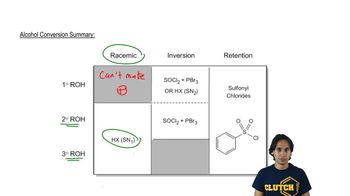
The conversion of an alcohol to an amine typically involves the substitution of the hydroxyl (-OH) group with an amine (-NH2) group. This can be achieved through various methods, such as using reagents like thionyl chloride (SOCl2) to convert the alcohol into a better leaving group, followed by nucleophilic substitution with ammonia or an amine.
Recommended video:
Guided course
04:30
Comparing and contrasting the Alcohol Conversions.

Nucleophilic Substitution Reactions

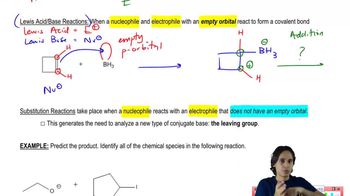
Nucleophilic substitution reactions are fundamental in organic chemistry, where a nucleophile attacks an electrophilic carbon atom, replacing a leaving group. In the context of alcohols, the hydroxyl group is a poor leaving group, so it is often converted into a better leaving group to facilitate the reaction with nucleophiles like amines.
Recommended video:
Guided course
01:47
Nucleophiles and Electrophiles can react in Substitution Reactions.

Reactivity of Alcohols

Alcohols are versatile compounds in organic synthesis, but their reactivity depends on the structure and the presence of functional groups. Primary alcohols can be converted to amines more readily than tertiary alcohols due to steric hindrance and the stability of the resulting carbocation during the reaction process.
Recommended video:
Guided course
01:01
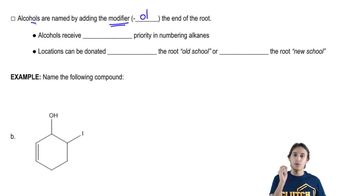
How to name alcohols