Ch. 16 - Reactions of Aldehydes and Ketones • More Reactions of Carboxylic Acid Derivatives
Bruice - Organic Chemistry 8th Edition
Bruice8th EditionOrganic ChemistryISBN: 9780135213711Not the one you use?Change textbook
Chapter 17, Problem 60f

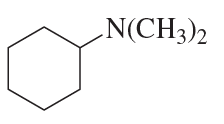
Using cyclohexanone as the starting material, describe how each of the following compounds can be synthesized:
f. Cyclohexanone structure with a dimethylamine group attached, illustrating imine or enamine synthesis.

Verified step by step guidance
1
Step 1: Begin with cyclohexanone as the starting material. Cyclohexanone is a ketone with the formula C₆H₁₀O. The goal is to convert the ketone group into a primary amine (-CH₂NH₂) attached to the cyclohexane ring.
Step 2: Perform a reductive amination reaction. Reductive amination is a common method to synthesize amines from ketones. First, react cyclohexanone with ammonia (NH₃) to form an imine intermediate. The imine is formed by the nucleophilic attack of ammonia on the carbonyl group of cyclohexanone, followed by the elimination of water.
Step 3: Reduce the imine intermediate to the corresponding amine. Use a reducing agent such as sodium cyanoborohydride (NaBH₃CN) or hydrogen gas (H₂) with a metal catalyst like palladium on carbon (Pd/C). This step converts the imine into the desired primary amine (-CH₂NH₂).
Step 4: Ensure the reaction conditions are mild to prevent over-reduction or side reactions. Sodium cyanoborohydride is often preferred for reductive amination because it selectively reduces imines without affecting other functional groups.
Step 5: Purify the product using techniques such as distillation or recrystallization, depending on the physical properties of the compound. Confirm the structure of the product using spectroscopic methods like NMR or IR to ensure the synthesis was successful.

Verified video answer for a similar problem:

This video solution was recommended by our tutors as helpful for the problem above.
Video duration:
2m
Was this helpful?

Key Concepts

Here are the essential concepts you must grasp in order to answer the question correctly.

Cyclohexanone

Cyclohexanone is a cyclic ketone with the formula C6H10O. It serves as a versatile starting material in organic synthesis due to its reactivity, particularly at the carbonyl group. This compound can undergo various reactions, including nucleophilic addition, which is essential for synthesizing amines and other derivatives.
Recommended video:
Guided course
01:20
Is the following disubstituted cyclohexane chiral?

Imine and Enamine Formation

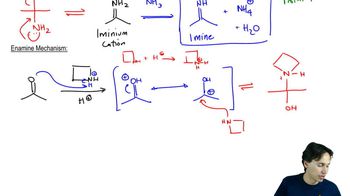
Imine and enamine formation are key reactions involving the condensation of carbonyl compounds with amines. An imine is formed when a primary amine reacts with a carbonyl compound, while an enamine is produced from a secondary amine. Understanding these mechanisms is crucial for synthesizing compounds from cyclohexanone, as they dictate the structure and reactivity of the resulting products.
Recommended video:
Guided course
06:25
Enamine Mechanism

Nucleophilic Addition Reactions

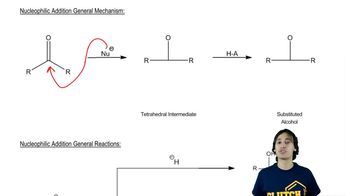
Nucleophilic addition reactions are fundamental in organic chemistry, where a nucleophile attacks an electrophilic carbon atom, such as the carbonyl carbon in cyclohexanone. This reaction is pivotal for forming new carbon-nitrogen bonds, which are essential in synthesizing amines and other nitrogen-containing compounds from cyclohexanone.
Recommended video:
Guided course
08:27
Nucleophilic Addition