Ch. 16 - Reactions of Aldehydes and Ketones • More Reactions of Carboxylic Acid Derivatives
Bruice - Organic Chemistry 8th Edition
Bruice8th EditionOrganic ChemistryISBN: 9780135213711Not the one you use?Change textbook
Chapter 17, Problem 52b

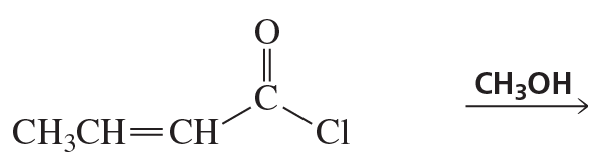
What is the major product of each of the following reactions?
b. Chemical structure showing a carbonyl compound with a chlorine atom and a methanol molecule indicating a reaction.

Verified step by step guidance
1
Step 1: Identify the functional groups in the reactant. The molecule contains an α,β-unsaturated acyl chloride group (C=O adjacent to a double bond) and a cyclohexane ring.
Step 2: Recognize the reagent CH₃OH (methanol). Methanol is an alcohol and can act as a nucleophile in this reaction.
Step 3: Understand the reaction mechanism. Acyl chlorides are highly reactive and undergo nucleophilic acyl substitution. Methanol will attack the carbonyl carbon of the acyl chloride, replacing the chlorine atom.
Step 4: Consider the stereochemistry and regioselectivity. Since the acyl chloride is part of an α,β-unsaturated system, the reaction will likely proceed without affecting the double bond, as the nucleophilic attack occurs at the carbonyl carbon.
Step 5: Predict the major product. The chlorine atom will be replaced by the methoxy group (-OCH₃), forming an ester. The double bond and cyclohexane ring remain unchanged.

Verified video answer for a similar problem:

This video solution was recommended by our tutors as helpful for the problem above.
Video duration:
5m
Was this helpful?

Key Concepts

Here are the essential concepts you must grasp in order to answer the question correctly.

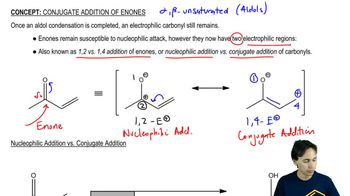
Conjugate Addition

Conjugate addition refers to the nucleophilic addition of a reagent to an α,β-unsaturated carbonyl compound. In this reaction, the nucleophile attacks the β-carbon, leading to the formation of a new bond while the double bond shifts. This process is crucial in organic synthesis as it allows for the formation of more complex molecules from simpler ones.
Recommended video:
Guided course
09:23
1,2 vs 1,4 Addition

Nucleophiles and Electrophiles

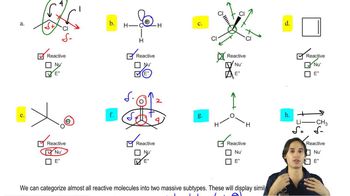
In organic chemistry, nucleophiles are species that donate an electron pair to form a chemical bond, while electrophiles are electron-deficient species that accept an electron pair. Understanding the roles of nucleophiles and electrophiles is essential for predicting the outcome of chemical reactions, such as the one depicted in the image, where methanol acts as a nucleophile attacking the electrophilic carbon in the conjugate addition.
Recommended video:
Guided course
03:
Nucleophile or Electrophile

Reaction Mechanism

A reaction mechanism outlines the step-by-step process by which reactants transform into products. It includes details about bond breaking and forming, intermediates, and transition states. Analyzing the mechanism of the conjugate addition reaction shown in the image helps in understanding how the major product is formed, including the role of methanol and the chlorine substituent.
Recommended video:
Guided course
02:16
Heck Reaction Mechanism