Ch. 16 - Reactions of Aldehydes and Ketones • More Reactions of Carboxylic Acid Derivatives
Bruice - Organic Chemistry 8th Edition
Bruice8th EditionOrganic ChemistryISBN: 9780135213711Not the one you use?Change textbook
Chapter 17, Problem 51c,d

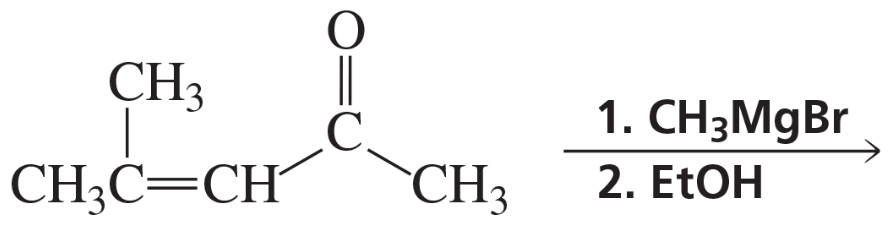
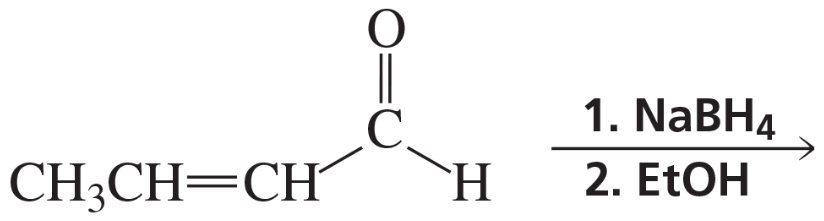
What is the major product of each of the following reactions?
c.
d.

Verified step by step guidance
1
Step 1: Analyze the reaction conditions for part (i). The reagent used is ethylmagnesium bromide (EtMgBr), a Grignard reagent, followed by ethanol (EtOH). Grignard reagents are nucleophiles that attack electrophilic carbonyl carbons, forming a new carbon-carbon bond.
Step 2: Identify the electrophilic site in the molecule for part (i). The aldehyde group (CHO) is the electrophilic site, and the Grignard reagent will attack the carbonyl carbon.
Step 3: Predict the intermediate for part (i). The attack of the Grignard reagent on the aldehyde will result in the formation of an alkoxide intermediate. This intermediate will then be protonated by ethanol to form the final alcohol product.
Step 4: Analyze the reaction conditions for part (ii). The reagent used is sodium borohydride (NaBH4), a reducing agent, followed by ethanol (EtOH). NaBH4 selectively reduces aldehydes and ketones to alcohols.
Step 5: Predict the product for part (ii). The aldehyde group (CHO) will be reduced to a primary alcohol. The double bond in the molecule will remain unaffected because NaBH4 does not reduce alkenes under these conditions.

Verified video answer for a similar problem:

This video solution was recommended by our tutors as helpful for the problem above.
Video duration:
8m
Was this helpful?

Key Concepts

Here are the essential concepts you must grasp in order to answer the question correctly.

Grignard Reagents

Grignard reagents, such as EtMgBr, are organomagnesium compounds that act as nucleophiles in organic reactions. They can react with carbonyl compounds to form alcohols. In the given reaction, the Grignard reagent adds to the carbonyl carbon, leading to the formation of a new carbon-carbon bond, followed by protonation in the presence of ethanol.
Recommended video:
Guided course
02:12
Carbonation of Grignard Reagents

Reduction Reactions

Reduction reactions involve the gain of electrons or the decrease in oxidation state of a molecule. In the context of organic chemistry, reducing agents like NaBH4 can convert carbonyl groups (aldehydes and ketones) into alcohols. The reaction shown in the second part of the question illustrates the reduction of a carbonyl compound to an alcohol using sodium borohydride.
Recommended video:
Guided course
07:12
Reductive Amination

Stereochemistry

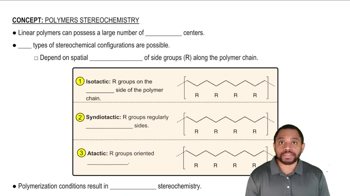
Stereochemistry is the study of the spatial arrangement of atoms in molecules and how this affects their chemical behavior. In reactions involving carbonyl compounds, the stereochemistry of the product can be influenced by the approach of nucleophiles and the configuration of the starting material. Understanding stereochemistry is crucial for predicting the major product in reactions involving chiral centers.
Recommended video:
1:38
Polymer Stereochemistry Concept 1