Ch. 17 - Reactions at the Alpha-Carbon
Bruice - Organic Chemistry 8th Edition
Bruice8th EditionOrganic ChemistryISBN: 9780135213711Not the one you use?Change textbook
Chapter 18, Problem 71b

b. What carboxylic acid is formed when the malonic ester synthesis is carried out with two equivalents of malonic ester, one equivalent of 1,5-dibromopentane, and two equivalents of base?

Verified step by step guidance
1
Step 1: Begin by understanding the malonic ester synthesis. This reaction involves the alkylation of malonic ester (diethyl malonate) using a base and an alkyl halide, followed by hydrolysis and decarboxylation to yield a carboxylic acid.
Step 2: In this case, two equivalents of malonic ester are used along with one equivalent of 1,5-dibromopentane and two equivalents of base (CH3CH2ONa). The base deprotonates the alpha-hydrogens of the malonic ester, making it nucleophilic.
Step 3: The nucleophilic malonic ester attacks the 1,5-dibromopentane, displacing one bromide ion and forming a bond between the malonic ester and the pentane chain. This step occurs twice due to the two equivalents of malonic ester, resulting in a molecule with two malonic ester groups attached to the pentane chain.
Step 4: The reaction mixture is then subjected to acidic hydrolysis (HCl, H2O), which converts the ester groups into carboxylic acids. This step yields a compound with two carboxylic acid groups attached to the pentane chain.
Step 5: Finally, decarboxylation occurs under heating (Δ), removing one of the carboxylic acid groups from each malonic acid moiety. The final product is a carboxylic acid with a single carboxylic acid group at each end of the pentane chain, resulting in 1,5-pentanedioic acid (glutaric acid).

Verified video answer for a similar problem:

This video solution was recommended by our tutors as helpful for the problem above.
Video duration:
6m
Was this helpful?

Key Concepts

Here are the essential concepts you must grasp in order to answer the question correctly.

Malonic Ester Synthesis

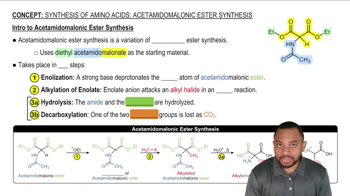
Malonic ester synthesis is a method for synthesizing carboxylic acids through the alkylation of malonic ester. In this reaction, a malonic ester is treated with a base to deprotonate one of its acidic protons, allowing it to act as a nucleophile. The nucleophilic malonic ester then reacts with an alkyl halide, such as 1,5-dibromopentane, leading to the formation of a substituted malonic ester, which can subsequently be hydrolyzed and decarboxylated to yield the final carboxylic acid product.
Recommended video:
3:33
Synthesis of Amino Acids: Acetamidomalonic Ester Synthesis Concept 1

Carboxylic Acids

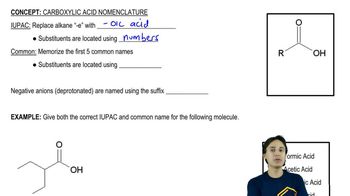
Carboxylic acids are organic compounds characterized by the presence of one or more carboxyl groups (-COOH). They are known for their acidic properties due to the ability of the carboxyl group to donate a proton (H+). In the context of malonic ester synthesis, the final product is a carboxylic acid that results from the hydrolysis and decarboxylation of the intermediate malonic ester, which is crucial for understanding the outcome of the reaction.
Recommended video:
Guided course
04:20
Carboxylic Acids Nomenclature

Base-Induced Reactions

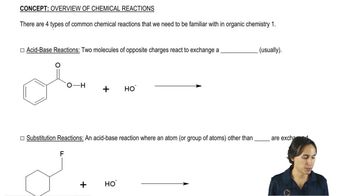
In organic chemistry, bases are often used to deprotonate acidic protons, facilitating nucleophilic attacks in various reactions. In the malonic ester synthesis, a strong base such as sodium ethoxide is employed to deprotonate the malonic ester, generating a nucleophile that can react with the alkyl halide. Understanding the role of the base is essential for predicting the reaction pathway and the formation of the desired carboxylic acid product.
Recommended video:
Guided course
02:43
Recognizing Acid-Base Reactions.