Ch. 17 - Reactions at the Alpha-Carbon
Bruice - Organic Chemistry 8th Edition
Bruice8th EditionOrganic ChemistryISBN: 9780135213711Not the one you use?Change textbook
Chapter 18, Problem 70

Compound A with molecular formula C6H10 has two peaks in its 1H NMR spectrum, both of which are singlets (with ratio 9 : 1). Compound A reacts with an acidic aqueous solution containing mercuric sulfate to form compound B, which gives a positive iodoform test (Problem 58) and has an 1H NMR spectrum that shows two singlets (with ratio 3 : 1). Identify A and B.

Verified step by step guidance
1
Analyze the molecular formula of compound A (C6H10). The degree of unsaturation can be calculated using the formula: \( \text{Degree of Unsaturation} = \frac{2C + 2 - H}{2} \), where C is the number of carbons and H is the number of hydrogens. For C6H10, \( \text{Degree of Unsaturation} = \frac{2(6) + 2 - 10}{2} = 2 \). This indicates two double bonds, one triple bond, or a ring structure.
Examine the 1H NMR data for compound A. The presence of two singlets in a 9:1 ratio suggests a highly symmetrical structure. A singlet with a ratio of 9 indicates a tert-butyl group \((\text{-C(CH3)3})\), and the singlet with a ratio of 1 suggests a single proton in a different environment.
Consider the reaction of compound A with acidic aqueous mercuric sulfate. This reagent is commonly used to hydrate alkynes, converting them into ketones via Markovnikov addition. This suggests that compound A contains a terminal alkyne group \((\text{-C≡CH})\). Combining this with the tert-butyl group, compound A is likely tert-butylacetylene \((\text{(CH3)3C-C≡CH})\).
Analyze compound B, the product of the hydration reaction. The hydration of a terminal alkyne like tert-butylacetylene produces a methyl ketone \((\text{(CH3)3C-COCH3})\). The positive iodoform test confirms the presence of a methyl ketone group. The 1H NMR spectrum of compound B shows two singlets in a 3:1 ratio, corresponding to the methyl group \((\text{-CH3})\) and the tert-butyl group \((\text{-C(CH3)3})\).
Summarize the findings: Compound A is tert-butylacetylene \((\text{(CH3)3C-C≡CH})\), and compound B is tert-butyl methyl ketone \((\text{(CH3)3C-COCH3})\). The reaction pathway involves the hydration of the terminal alkyne to form the methyl ketone, consistent with the given data.

Verified video answer for a similar problem:

This video solution was recommended by our tutors as helpful for the problem above.
Video duration:
6m
Was this helpful?

Key Concepts

Here are the essential concepts you must grasp in order to answer the question correctly.

NMR Spectroscopy

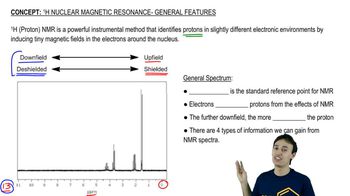
Nuclear Magnetic Resonance (NMR) spectroscopy is a powerful analytical technique used to determine the structure of organic compounds. It provides information about the number of hydrogen atoms in different environments within a molecule, indicated by peaks in the spectrum. The splitting patterns and integration of these peaks help identify the types of hydrogen present and their relative ratios, which are crucial for deducing molecular structure.
Recommended video:
Guided course
10:06
General NMR Features

Iodoform Test

The iodoform test is a qualitative reaction used to identify methyl ketones and certain alcohols. When a compound containing a methyl group adjacent to a carbonyl group is treated with iodine and a base, it forms a yellow precipitate of iodoform (CHI3). A positive result indicates the presence of a specific structural feature, which aids in the identification of compound B in this context.
Recommended video:
Guided course
11:40
Q-Test (Proton Relationships)

Structural Isomerism

Structural isomerism occurs when compounds have the same molecular formula but different structural arrangements of atoms. In the case of compounds A and B, understanding the types of isomerism, such as positional or functional group isomerism, is essential for identifying the correct structures based on their reactivity and spectral data. This concept is key to solving the problem by determining how the compounds relate to each other.
Recommended video:
Guided course
06:47
Monosaccharides - D and L Isomerism