Ch. 17 - Reactions at the Alpha-Carbon
Bruice - Organic Chemistry 8th Edition
Bruice8th EditionOrganic ChemistryISBN: 9780135213711Not the one you use?Change textbook
Chapter 18, Problem 17a

Describe how the following compounds could be prepared from cyclohexanone using an enamine intermediate:
a.

Verified step by step guidance
1
Step 1: Begin with cyclohexanone as the starting material. Cyclohexanone is a six-membered cyclic ketone with a carbonyl group (C=O).
Step 2: React cyclohexanone with a secondary amine (e.g., pyrrolidine) and a catalytic amount of an acid to form an enamine intermediate. The enamine is formed by the condensation of the ketone with the amine, where the carbonyl oxygen is replaced by a nitrogen group, and a double bond forms between the alpha-carbon and the adjacent carbon.
Step 3: Perform an alkylation reaction on the enamine intermediate. Treat the enamine with an alkyl halide (e.g., 1-bromobutane) to introduce the butyl group at the alpha-carbon of the cyclohexanone. The enamine acts as a nucleophile, attacking the electrophilic carbon of the alkyl halide, leading to the substitution of the halide with the butyl group.
Step 4: Hydrolyze the alkylated enamine back to the ketone. This is achieved by treating the product with aqueous acid, which regenerates the carbonyl group and removes the amine, yielding the desired alkylated ketone.
Step 5: Verify the structure of the final product. The product should be 2-butylcyclohexanone, where the butyl group is attached to the alpha-carbon of the cyclohexanone ring.

Verified video answer for a similar problem:

This video solution was recommended by our tutors as helpful for the problem above.
Video duration:
6m
Was this helpful?

Key Concepts

Here are the essential concepts you must grasp in order to answer the question correctly.

Enamine Chemistry

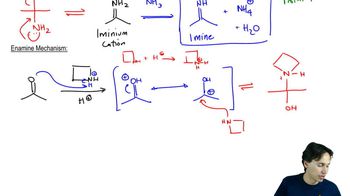
Enamines are formed by the reaction of a carbonyl compound, like cyclohexanone, with a secondary amine. This reaction involves the nucleophilic attack of the amine on the carbonyl carbon, followed by dehydration to yield the enamine. Enamines serve as versatile intermediates in organic synthesis, allowing for the formation of various products through electrophilic addition reactions.
Recommended video:
Guided course
06:25
Enamine Mechanism

Cyclohexanone Structure and Reactivity

Cyclohexanone is a cyclic ketone with a six-membered carbon ring and a carbonyl group (C=O). Its structure makes it a good candidate for enamine formation due to the stability of the resulting enamine. The reactivity of cyclohexanone allows it to undergo various transformations, including nucleophilic additions and substitutions, which are essential for synthesizing different compounds.
Recommended video:
Guided course
01:17
Reactivity of Molecules

Synthetic Pathways in Organic Chemistry

Synthetic pathways refer to the series of chemical reactions that transform starting materials into desired products. Understanding these pathways is crucial for predicting how to prepare specific compounds from intermediates like enamines. In this context, the ability to manipulate reaction conditions and select appropriate reagents is key to achieving the desired transformations from cyclohexanone.
Recommended video:
2:13
Energy Production In Biochemical Pathways Concept 1