Ch. 17 - Reactions at the Alpha-Carbon
Bruice - Organic Chemistry 8th Edition
Bruice8th EditionOrganic ChemistryISBN: 9780135213711Not the one you use?Change textbook
Chapter 18, Problem 18a

Draw the products of the following reactions:
a. Chemical reaction diagram showing the Michael addition of two reactants with structural formulas and products indicated.

Verified step by step guidance
1
Step 1: Analyze the reactants and reaction conditions. The first reactant is an α,β-unsaturated amide, and the second reactant is a β-diketone. The reaction conditions include methoxide ion (CH₃O⁻) in methanol (CH₃OH), which suggests a base-catalyzed reaction.
Step 2: Recognize the likely reaction mechanism. The methoxide ion will deprotonate the β-diketone at the most acidic hydrogen (the central hydrogen between the two carbonyl groups), forming an enolate ion. This enolate is nucleophilic and can attack the electrophilic carbon of the α,β-unsaturated amide.
Step 3: Identify the electrophilic site in the α,β-unsaturated amide. The β-carbon of the double bond is electrophilic due to conjugation with the carbonyl group. The nucleophilic enolate will perform a Michael addition to this β-carbon.
Step 4: Predict the intermediate formed after the Michael addition. The enolate adds to the β-carbon, breaking the double bond and forming a new single bond. The resulting intermediate will have a new carbon-carbon bond and a negatively charged oxygen atom from the enolate.
Step 5: Consider the final product after protonation. The negatively charged oxygen atom in the intermediate will be protonated by methanol, forming a stable product. The final product will be a β-keto amide with the new carbon-carbon bond formed during the Michael addition.

Verified video answer for a similar problem:

This video solution was recommended by our tutors as helpful for the problem above.
Video duration:
5m
Was this helpful?

Key Concepts

Here are the essential concepts you must grasp in order to answer the question correctly.

Michael Addition

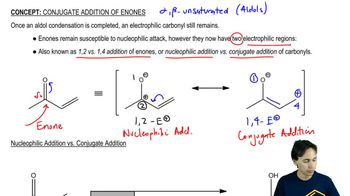
Michael addition is a nucleophilic addition reaction where a nucleophile adds to an α,β-unsaturated carbonyl compound. In this reaction, the nucleophile attacks the β-carbon of the double bond, leading to the formation of a new carbon-carbon bond. This reaction is crucial in organic synthesis for constructing complex molecules and is often used in the formation of larger cyclic structures.
Recommended video:
Guided course
09:23
1,2 vs 1,4 Addition

Nucleophiles and Electrophiles

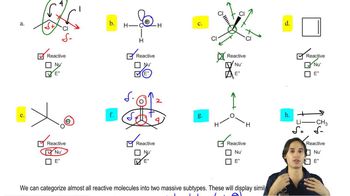
In organic chemistry, nucleophiles are species that donate an electron pair to form a chemical bond, while electrophiles are electron-deficient species that accept an electron pair. Understanding the roles of nucleophiles and electrophiles is essential for predicting the outcome of reactions, such as the Michael addition, where the nucleophile attacks the electrophilic carbon of the unsaturated carbonyl compound.
Recommended video:
Guided course
03:
Nucleophile or Electrophile

Reaction Mechanism

A reaction mechanism is a step-by-step description of the process by which reactants are converted into products. It outlines the sequence of bond-breaking and bond-forming events, providing insight into the intermediates and transition states involved. Analyzing the mechanism of the Michael addition helps in understanding how the reaction proceeds and the factors that influence its rate and selectivity.
Recommended video:
Guided course
02:16
Heck Reaction Mechanism