Ch. 17 - Reactions at the Alpha-Carbon
Bruice - Organic Chemistry 8th Edition
Bruice8th EditionOrganic ChemistryISBN: 9780135213711Not the one you use?Change textbook
Chapter 18, Problem 48d

Draw a structure for each of the following: d. the enol tautomer of cyclopentanone

Verified step by step guidance
1
Understand the concept of keto-enol tautomerism: Keto-enol tautomerism is a chemical equilibrium between a ketone (or aldehyde) and its corresponding enol form. The enol form contains a hydroxyl group (-OH) directly bonded to a carbon-carbon double bond (C=C). This equilibrium is facilitated by the movement of a proton and the rearrangement of a double bond.
Identify the structure of cyclopentanone: Cyclopentanone is a cyclic ketone with a five-membered ring and a carbonyl group (C=O) at one of the carbons. Its molecular formula is C5H8O.
Determine the enol form: To convert cyclopentanone to its enol tautomer, a hydrogen atom from an alpha-carbon (a carbon adjacent to the carbonyl group) is transferred to the oxygen atom of the carbonyl group, forming a hydroxyl group (-OH). Simultaneously, a double bond forms between the alpha-carbon and the carbonyl carbon.
Draw the enol structure: The enol tautomer of cyclopentanone will have a five-membered ring with a hydroxyl group (-OH) attached to one carbon and a carbon-carbon double bond (C=C) between the former carbonyl carbon and an alpha-carbon.
Verify the structure: Ensure that the enol structure satisfies the valency of all atoms and that the hydroxyl group is directly bonded to a carbon involved in the double bond. This confirms the correct enol tautomer of cyclopentanone.

Verified video answer for a similar problem:

This video solution was recommended by our tutors as helpful for the problem above.
Video duration:
1m
Was this helpful?

Key Concepts

Here are the essential concepts you must grasp in order to answer the question correctly.

Tautomerism

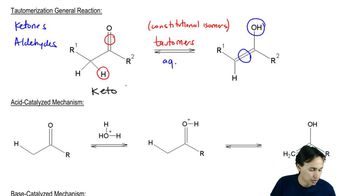
Tautomerism is a chemical phenomenon where two or more structural isomers, known as tautomers, readily interconvert. This process typically involves the relocation of a hydrogen atom and a shift of a double bond. In the case of ketones and enols, the keto form (like cyclopentanone) can convert to its enol form, which features a hydroxyl group and a double bond.
Recommended video:
Guided course
05:11
Tautomerization Mechanisms

Enol Structure

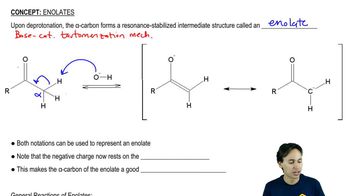
An enol is a type of compound that contains a carbon-carbon double bond (C=C) and a hydroxyl group (–OH) attached to one of the carbons. The enol form is often less stable than its keto counterpart but plays a significant role in various chemical reactions, including those involving nucleophiles. Understanding the structure of enols is crucial for recognizing their reactivity and properties.
Recommended video:
Guided course
02:26
Formation of Enolates

Cyclopentanone

Cyclopentanone is a cyclic ketone with the molecular formula C5H8O, characterized by a five-membered carbon ring containing a carbonyl group (C=O). The presence of the carbonyl group makes it a key player in tautomeric equilibria, as it can easily convert to its enol form. Recognizing the structure of cyclopentanone is essential for drawing its enol tautomer accurately.
Recommended video:
Guided course
00:21
Is the following disubstituted cyclopentane chiral?