Ch. 17 - Reactions at the Alpha-Carbon
Bruice - Organic Chemistry 8th Edition
Bruice8th EditionOrganic ChemistryISBN: 9780135213711Not the one you use?Change textbook
Chapter 18, Problem 6

Explain why 92% of 2,4-pentanedione exists as the enol tautomer in hexane but only 15% of this compound exists as the enol tautomer in water.

Verified step by step guidance
1
Understand the concept of keto-enol tautomerism: Keto-enol tautomerism is a chemical equilibrium between a ketone (or aldehyde) and its corresponding enol form. The equilibrium depends on the stability of each tautomer, which is influenced by the solvent and other factors.
Analyze the structure of 2,4-pentanedione: This compound has two carbonyl groups (C=O) separated by a single methylene group (-CH2-). The enol form involves the migration of a hydrogen atom and the formation of a double bond between the alpha-carbon and one of the carbonyl carbons, along with the formation of an -OH group.
Consider the role of the solvent hexane: Hexane is a nonpolar solvent. In nonpolar environments, the enol form of 2,4-pentanedione is stabilized by intramolecular hydrogen bonding between the hydroxyl (-OH) group and the adjacent carbonyl oxygen. This intramolecular hydrogen bonding significantly increases the stability of the enol tautomer in hexane.
Consider the role of the solvent water: Water is a polar solvent and can form hydrogen bonds with the keto form of 2,4-pentanedione. The keto form is more polar than the enol form, so it is better stabilized by the polar environment of water. Additionally, the intramolecular hydrogen bonding that stabilizes the enol form in hexane is less significant in water due to competition with water molecules for hydrogen bonding.
Conclude the reasoning: The high percentage of the enol tautomer in hexane (92%) is due to the stabilization provided by intramolecular hydrogen bonding in the nonpolar solvent. In contrast, the lower percentage of the enol tautomer in water (15%) is due to the polar solvent stabilizing the keto form more effectively through hydrogen bonding and solvation effects.

Verified video answer for a similar problem:

This video solution was recommended by our tutors as helpful for the problem above.
Video duration:
4m
Was this helpful?

Key Concepts

Here are the essential concepts you must grasp in order to answer the question correctly.

Tautomerism

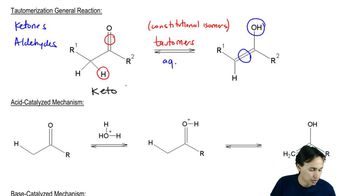
Tautomerism is a chemical phenomenon where two or more structural isomers, known as tautomers, readily interconvert. In the case of 2,4-pentanedione, the keto form and the enol form are tautomers. The stability of these forms can vary significantly depending on the solvent and environmental conditions, influencing the equilibrium between them.
Recommended video:
Guided course
05:11
Tautomerization Mechanisms

Solvent Effects on Tautomerism

The solvent plays a crucial role in determining the stability of tautomers. In nonpolar solvents like hexane, the enol form of 2,4-pentanedione is favored due to reduced hydrogen bonding and steric interactions, allowing for a higher percentage of the enol tautomer. Conversely, in polar solvents like water, the keto form is stabilized through hydrogen bonding, leading to a lower percentage of the enol form.
Recommended video:
Guided course
05:11
Tautomerization Mechanisms

Hydrogen Bonding

Hydrogen bonding is a strong type of dipole-dipole interaction that occurs when a hydrogen atom covalently bonded to an electronegative atom interacts with another electronegative atom. In water, the ability of the solvent to form extensive hydrogen bonds stabilizes the keto form of 2,4-pentanedione, thus reducing the proportion of the enol tautomer compared to nonpolar solvents where such interactions are minimal.
Recommended video:
Guided course
00:48
The definition of hydrogenation.