Ch. 18 - Reactions of Benzene and Substituted Benzenes
Bruice - Organic Chemistry 8th Edition
Bruice8th EditionOrganic ChemistryISBN: 9780135213711Not the one you use?Change textbook
Chapter 19, Problem 38

Draw resonance contributors for the carbanion that would be formed if meta-chloronitrobenzene were to react with hydroxide ion. Why doesn't the reaction occur?

Verified step by step guidance
1
Step 1: Understand the structure of meta-chloronitrobenzene. It is a benzene ring with a chlorine atom at the meta position and a nitro group (-NO₂) also at the meta position. The hydroxide ion (OH⁻) is a strong nucleophile and base.
Step 2: Consider the reaction mechanism. If hydroxide ion were to react with meta-chloronitrobenzene, it would likely attack the carbon atom bonded to the chlorine atom, leading to the formation of a carbanion intermediate after the departure of the chloride ion (Cl⁻).
Step 3: Draw the resonance contributors for the carbanion intermediate. The negative charge on the carbon atom can delocalize into the benzene ring. Use curved arrows to show the movement of electrons, and draw resonance structures where the negative charge is distributed to the ortho and para positions relative to the nitro group. The nitro group, being an electron-withdrawing group, stabilizes the negative charge through resonance and inductive effects.
Step 4: Analyze why the reaction does not occur. The chlorine atom in meta-chloronitrobenzene is not a good leaving group under these conditions because the reaction would require breaking a strong C-Cl bond. Additionally, the meta position of the nitro group does not provide optimal stabilization for the carbanion intermediate compared to an ortho or para position.
Step 5: Conclude that the reaction is unfavorable. The combination of a poor leaving group (chlorine) and insufficient stabilization of the carbanion intermediate makes the reaction thermodynamically and kinetically unfavorable. Therefore, hydroxide ion does not react with meta-chloronitrobenzene under normal conditions.

Verified video answer for a similar problem:

This video solution was recommended by our tutors as helpful for the problem above.
Video duration:
10m
Was this helpful?

Key Concepts

Here are the essential concepts you must grasp in order to answer the question correctly.

Resonance Structures

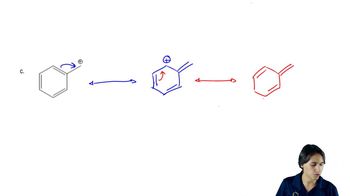
Resonance structures are different Lewis structures for the same molecule that illustrate the delocalization of electrons. In the case of carbanions, resonance can stabilize the negative charge by spreading it over multiple atoms. Understanding how to draw these structures helps predict the stability and reactivity of intermediates in organic reactions.
Recommended video:
Guided course
03:04
Drawing Resonance Structures

Carbanion Stability

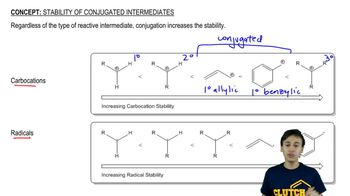
Carbanions are negatively charged carbon species that can be stabilized by electron-withdrawing groups through resonance or inductive effects. The stability of a carbanion is crucial in determining whether a reaction will proceed; more stable carbanions are less reactive. In meta-chloronitrobenzene, the positioning of substituents affects the carbanion's stability and reactivity.
Recommended video:
Guided course
04:31
Stability of Conjugated Intermediates

Nucleophilic Substitution Reactions

Nucleophilic substitution reactions involve the replacement of a leaving group by a nucleophile. The reactivity of the substrate and the nature of the nucleophile are key factors in these reactions. In the case of meta-chloronitrobenzene, the electron-withdrawing nitro group decreases the nucleophilicity of hydroxide ion, making the reaction less favorable.
Recommended video:
Guided course
01:47
Nucleophiles and Electrophiles can react in Substitution Reactions.