Ch. 18 - Reactions of Benzene and Substituted Benzenes
Bruice - Organic Chemistry 8th Edition
Bruice8th EditionOrganic ChemistryISBN: 9780135213711Not the one you use?Change textbook
Chapter 19, Problem 40c

Show how each of the following compounds can be synthesized from benzene:
c. p-bromoanisole

Verified step by step guidance
1
Step 1: Begin with benzene as the starting material. Benzene is a simple aromatic compound that serves as the foundation for the synthesis.
Step 2: Introduce a bromine substituent to the benzene ring by performing an electrophilic aromatic substitution (EAS) reaction. Use bromine (Br₂) and a Lewis acid catalyst such as FeBr₃ to brominate benzene, forming bromobenzene. The reaction mechanism involves the formation of a bromonium ion intermediate.
Step 3: Protect the para position for the next substitution. To achieve the desired para orientation, introduce a methoxy group (-OCH₃) to the benzene ring. This can be done by reacting bromobenzene with sodium methoxide (NaOCH₃) in the presence of a suitable solvent like methanol. The methoxy group is an electron-donating group and directs further substitution to the para position.
Step 4: Ensure that the bromine and methoxy groups are in the correct para relationship. If the reaction conditions are controlled properly, the methoxy group will be introduced at the para position relative to the bromine substituent, yielding p-bromoanisole.
Step 5: Purify the product using techniques such as recrystallization or column chromatography to isolate p-bromoanisole. Confirm the structure of the compound using spectroscopic methods like NMR or IR to verify the presence of the bromine and methoxy groups in the para positions.

Verified video answer for a similar problem:

This video solution was recommended by our tutors as helpful for the problem above.
Video duration:
5m
Was this helpful?

Key Concepts

Here are the essential concepts you must grasp in order to answer the question correctly.

Electrophilic Aromatic Substitution

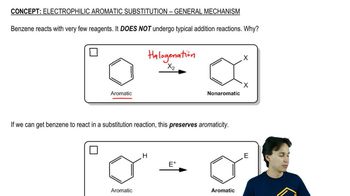
Electrophilic aromatic substitution (EAS) is a fundamental reaction in organic chemistry where an electrophile replaces a hydrogen atom on an aromatic ring. This process is crucial for synthesizing various aromatic compounds, including p-bromoanisole from benzene. Understanding the mechanism of EAS, including the role of catalysts and the stability of intermediates, is essential for predicting the outcomes of such reactions.
Recommended video:

Bromination of Aromatic Compounds

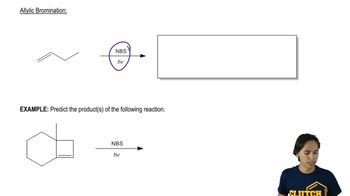
Bromination is a specific type of electrophilic aromatic substitution where bromine is introduced into an aromatic compound. In the synthesis of p-bromoanisole, bromine can be added to the benzene ring after it has been activated by a methoxy group (from anisole). This step is critical as it determines the position of the bromine substitution, which in this case is para to the methoxy group due to its electron-donating properties.
Recommended video:
Guided course
00:54
Mechanism of Allylic Bromination.

Methoxy Group as a Director

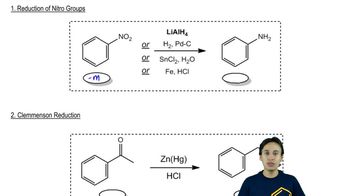
The methoxy group (-OCH3) is an electron-donating substituent that influences the reactivity and orientation of electrophilic substitution on the aromatic ring. It directs incoming electrophiles to the ortho and para positions relative to itself. In the synthesis of p-bromoanisole, the methoxy group enhances the electron density of the benzene ring, facilitating the bromination at the para position, which is a key aspect of the synthesis process.
Recommended video:
Guided course
04:42
Sequence Groups