Ch. 18 - Reactions of Benzene and Substituted Benzenes
Bruice - Organic Chemistry 8th Edition
Bruice8th EditionOrganic ChemistryISBN: 9780135213711Not the one you use?Change textbook
Chapter 19, Problem 33

In the mechanism for electrophilic aromatic substitution with a diazonium ion as the electrophile, why does nucleophilic attack occur on the terminal nitrogen of the diazonium ion rather than on the nitrogen that has the formal positive charge?

Verified step by step guidance
1
Understand the structure of the diazonium ion: A diazonium ion has the general structure R-N≡N⁺, where the nitrogen with the formal positive charge is directly bonded to the aromatic ring (R), and the terminal nitrogen is triple-bonded to it.
Recognize the electrophilic nature of the diazonium ion: The diazonium ion is an electrophile because the positive charge on the nitrogen makes the molecule electron-deficient, and it seeks electrons from a nucleophile (in this case, the aromatic ring).
Analyze the electron density distribution: The triple bond between the two nitrogens in the diazonium ion is highly polarized. The terminal nitrogen is more electron-deficient because it is directly bonded to the positively charged nitrogen, which pulls electron density away from it. This makes the terminal nitrogen the most electrophilic site.
Consider steric and electronic factors: The nitrogen with the formal positive charge is directly bonded to the aromatic ring, which creates steric hindrance and reduces its accessibility for nucleophilic attack. Additionally, the terminal nitrogen is more accessible for the nucleophile.
Conclude why the terminal nitrogen is attacked: The nucleophilic aromatic ring attacks the terminal nitrogen because it is the most electrophilic site due to electron deficiency and is sterically more accessible compared to the nitrogen with the formal positive charge.

Verified video answer for a similar problem:

This video solution was recommended by our tutors as helpful for the problem above.
Was this helpful?

Key Concepts

Here are the essential concepts you must grasp in order to answer the question correctly.

Electrophilic Aromatic Substitution (EAS)

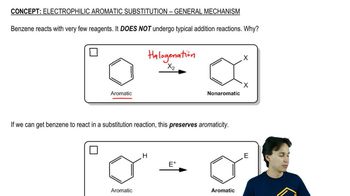
Electrophilic Aromatic Substitution is a fundamental reaction in organic chemistry where an electrophile replaces a hydrogen atom on an aromatic ring. This process involves the formation of a sigma complex, where the aromaticity of the ring is temporarily lost. Understanding EAS is crucial for analyzing how different electrophiles, such as diazonium ions, interact with aromatic compounds.
Recommended video:

Diazonium Ion Structure

Diazonium ions are a class of electrophiles characterized by a positively charged nitrogen atom bonded to a nitrogen double bond (N≡N). The terminal nitrogen, which is not positively charged, is more nucleophilic due to its ability to donate electrons. Recognizing the structure and reactivity of diazonium ions helps explain why nucleophilic attack occurs preferentially at the terminal nitrogen.
Recommended video:
3:39
Metal Ion Catalysis Concept 1

Nucleophilicity and Electrophilicity

Nucleophilicity refers to the ability of a species to donate an electron pair, while electrophilicity is the ability to accept an electron pair. In the context of the diazonium ion, the terminal nitrogen is more nucleophilic than the positively charged nitrogen, making it a more favorable site for nucleophilic attack. Understanding these concepts is essential for predicting the outcomes of reactions involving electrophiles and nucleophiles.
Recommended video:
Guided course
03:
Nucleophile or Electrophile