Ch. 18 - Reactions of Benzene and Substituted Benzenes
Bruice - Organic Chemistry 8th Edition
Bruice8th EditionOrganic ChemistryISBN: 9780135213711Not the one you use?Change textbook
Chapter 19, Problem 32

What product is formed from the reaction of p-methylphenol with benzenediazonium chloride?

Verified step by step guidance
1
Step 1: Recognize the type of reaction. This is an example of an electrophilic aromatic substitution reaction, specifically a diazo coupling reaction, where benzenediazonium chloride acts as an electrophile and p-methylphenol acts as a nucleophile.
Step 2: Identify the reactive site on p-methylphenol. The hydroxyl (-OH) group on the phenol ring is an activating group that increases electron density on the aromatic ring, especially at the ortho and para positions relative to the -OH group. Since the methyl group is already at the para position, the coupling will likely occur at the ortho position.
Step 3: Understand the mechanism. The diazonium ion (N≡N⁺) from benzenediazonium chloride attacks the electron-rich ortho position of p-methylphenol, forming a new bond between the aromatic ring of p-methylphenol and the diazonium group.
Step 4: Consider resonance stabilization. The resulting product will have conjugation between the aromatic ring and the azo (-N=N-) group, which stabilizes the molecule. This conjugation is responsible for the vibrant colors of azo compounds.
Step 5: Name the product. The final product is an azo compound, specifically 2-(p-methylphenylazo)-p-methylphenol, where the azo group (-N=N-) connects the p-methylphenol and the benzene ring from benzenediazonium chloride.

Verified video answer for a similar problem:

This video solution was recommended by our tutors as helpful for the problem above.
Video duration:
3m
Was this helpful?

Key Concepts

Here are the essential concepts you must grasp in order to answer the question correctly.

Electrophilic Aromatic Substitution

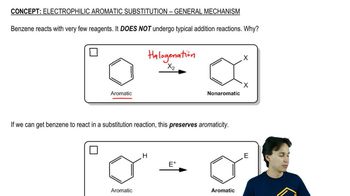
Electrophilic aromatic substitution (EAS) is a fundamental reaction in organic chemistry where an electrophile replaces a hydrogen atom on an aromatic ring. In this context, benzenediazonium chloride acts as the electrophile, which can react with the electron-rich p-methylphenol, leading to the substitution of a hydrogen atom on the aromatic ring.
Recommended video:

Aromatic Compounds

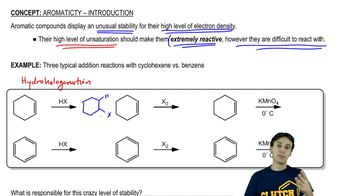
Aromatic compounds are a class of cyclic compounds characterized by their stable ring structure and delocalized π-electrons. p-Methylphenol, also known as p-cresol, is an aromatic compound that contains a hydroxyl group (-OH) and a methyl group (-CH3) attached to a benzene ring, influencing its reactivity in electrophilic substitution reactions.
Recommended video:
Guided course
08:19
Intro to Aromaticity

Diazonium Salts

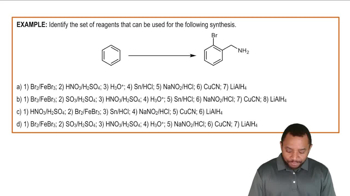
Diazonium salts are highly reactive intermediates in organic synthesis, formed by the reaction of primary aromatic amines with nitrous acid. Benzenediazonium chloride is a common diazonium salt that can participate in various coupling reactions, including those with aromatic compounds like p-methylphenol, resulting in the formation of azo compounds.
Recommended video:
4:54
Review of Nitriles Example 5