Ch. 18 - Reactions of Benzene and Substituted Benzenes
Bruice - Organic Chemistry 8th Edition
Bruice8th EditionOrganic ChemistryISBN: 9780135213711Not the one you use?Change textbook
Chapter 19, Problem 88b

Propose a mechanism for each of the following reactions:
b.

Verified step by step guidance
1
Step 1: Identify the functional groups present in the reactants and the type of reaction. Look for any nucleophiles, electrophiles, or leaving groups that might be involved in the mechanism.
Step 2: Determine the first step of the mechanism, which often involves the formation of a reactive intermediate. This could be the attack of a nucleophile on an electrophile or the departure of a leaving group.
Step 3: Consider any rearrangements or shifts that might occur in the intermediate. This could involve carbocation rearrangements or shifts of electrons to stabilize the intermediate.
Step 4: Identify the final step where the product is formed. This often involves the stabilization of the intermediate and the formation of new bonds.
Step 5: Review the entire mechanism to ensure that it follows the principles of organic chemistry, such as charge conservation and the stability of intermediates. Make sure each step logically leads to the next and results in the final product.

Verified video answer for a similar problem:

This video solution was recommended by our tutors as helpful for the problem above.
Video duration:
10m
Was this helpful?

Key Concepts

Here are the essential concepts you must grasp in order to answer the question correctly.

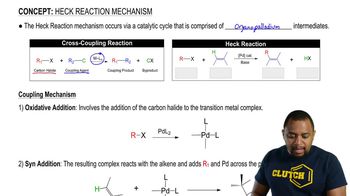
Reaction Mechanism

A reaction mechanism is a step-by-step description of how reactants transform into products in a chemical reaction. It outlines the sequence of elementary steps, including bond breaking and formation, and the intermediates formed during the process. Understanding the mechanism is crucial for predicting the outcome of reactions and for designing new synthetic pathways.
Recommended video:
Guided course
02:16
Heck Reaction Mechanism

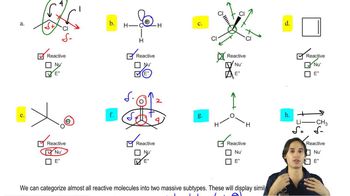
Nucleophiles and Electrophiles

Nucleophiles are species that donate an electron pair to form a chemical bond, while electrophiles are electron-deficient species that accept an electron pair. The interaction between nucleophiles and electrophiles is fundamental in organic reactions, as it drives the formation of new bonds. Identifying these species in a reaction helps in predicting the mechanism and the products formed.
Recommended video:
Guided course
03:
Nucleophile or Electrophile

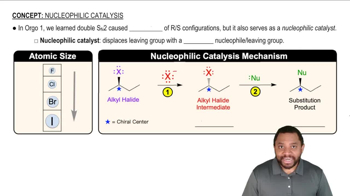
Catalysis

Catalysis refers to the process of increasing the rate of a chemical reaction by adding a substance known as a catalyst, which is not consumed in the reaction. Catalysts can provide an alternative pathway with a lower activation energy, making reactions more efficient. Understanding the role of catalysts is essential for proposing mechanisms, especially in complex organic reactions.
Recommended video:
2:31
Nucleophilic Catalysis Concept 1
Related Practice
Textbook Question

Show how the following compounds can be prepared from benzene:

c.

1158
views

Textbook Question

The pKa values of a few ortho-, meta-, and para-substituted benzoic acids are shown below:

The relative pKa values depend on the substituent. For chloro-substituted benzoic acids, the ortho isomer is the most acidic and the para isomer is the least acidic; for nitro-substituted benzoic acids, the ortho isomer is the most acidic and the meta isomer is the least acidic; and for amino-substituted benzoic acids, the meta isomer is the most acidic and the ortho isomer is the least acidic. Explain these relative acidities.

c. NH2: meta > para > ortho

657
views
Textbook Question

When heated with chromic acid, compound A forms benzoic acid. Identify compound A from its 1H NMR spectrum.

<IMAGE>

1265
views
Textbook Question

How can you distinguish the following compounds using: a. their infrared spectra?

1426
views
Textbook Question

The pKa values of a few ortho-, meta-, and para-substituted benzoic acids are shown below:

The relative pKa values depend on the substituent. For chloro-substituted benzoic acids, the ortho isomer is the most acidic and the para isomer is the least acidic; for nitro-substituted benzoic acids, the ortho isomer is the most acidic and the meta isomer is the least acidic; and for amino-substituted benzoic acids, the meta isomer is the most acidic and the ortho isomer is the least acidic.

Explain these relative acidities.

a. Cl: ortho > meta > para

4577
views
Textbook Question

Propose a mechanism for each of the following reactions:

a.

1043
views