Ch. 18 - Reactions of Benzene and Substituted Benzenes
Bruice - Organic Chemistry 8th Edition
Bruice8th EditionOrganic ChemistryISBN: 9780135213711Not the one you use?Change textbook
Chapter 19, Problem 91c

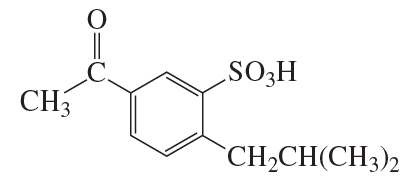
Show how the following compounds can be prepared from benzene:
c. Chemical structure of a compound derived from benzene, featuring a sulfonic acid and a ketone functional group.

Verified step by step guidance
1
Step 1: Identify the target compound and determine the functional group(s) present. For example, if the target compound is a substituted benzene derivative, note the type and position of substituents (e.g., nitro group, alkyl group, halogen, etc.).
Step 2: Analyze the synthetic pathway by considering the reagents and reactions required to introduce the functional group(s) onto the benzene ring. For example, electrophilic aromatic substitution (EAS) reactions such as nitration, halogenation, alkylation, or acylation are commonly used.
Step 3: Plan the sequence of reactions. If multiple substituents are present, consider the directing effects of existing groups (ortho/para-directing or meta-directing) to ensure the correct regioselectivity. For example, a nitro group is meta-directing, while an alkyl group is ortho/para-directing.
Step 4: Write the reaction conditions for each step. For example, nitration of benzene requires concentrated HNO₃ and H₂SO₄, while Friedel-Crafts alkylation requires an alkyl halide and AlCl₃ as a catalyst.
Step 5: Verify the feasibility of the synthesis by ensuring that the reagents and conditions used in each step are compatible and do not interfere with other functional groups already present on the benzene ring.

Verified video answer for a similar problem:

This video solution was recommended by our tutors as helpful for the problem above.
Was this helpful?

Key Concepts

Here are the essential concepts you must grasp in order to answer the question correctly.

Electrophilic Aromatic Substitution

Electrophilic aromatic substitution (EAS) is a fundamental reaction in organic chemistry where an electrophile replaces a hydrogen atom on an aromatic ring, such as benzene. This process is crucial for synthesizing various aromatic compounds, as it allows for the introduction of different functional groups onto the benzene ring, thereby modifying its chemical properties.
Recommended video:

Reagents and Conditions

Different reagents and conditions are required for specific electrophilic aromatic substitution reactions. For example, the use of bromine with a catalyst like FeBr3 can facilitate bromination, while nitration requires a mixture of concentrated nitric and sulfuric acids. Understanding the appropriate reagents and reaction conditions is essential for successfully preparing desired compounds from benzene.
Recommended video:

Functional Group Transformation

Functional group transformation refers to the process of converting one functional group into another through chemical reactions. In the context of benzene derivatives, this concept is vital as it allows chemists to modify the properties of the aromatic compound by introducing or altering functional groups, thus enabling the synthesis of a wide range of organic molecules.
Recommended video:
Guided course
02:36
Identifying Functional Groups