Ch. 19 - More About Amines • Reactions of Heterocyclic Compounds
Bruice - Organic Chemistry 8th Edition
Bruice8th EditionOrganic ChemistryISBN: 9780135213711Not the one you use?Change textbook
Chapter 20, Problem 39b

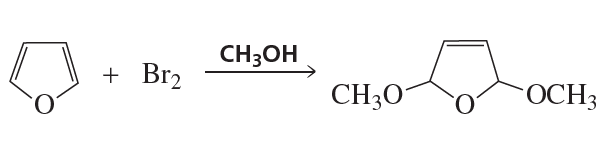
Propose a mechanism for the following reactions:
b. Chemical reaction showing the addition of Br2 to a compound in methanol, resulting in a product with two methoxy groups.

Verified step by step guidance
1
Step 1: Analyze the reactants and products. The reactant is thiophene, a sulfur-containing aromatic compound, reacting with bromine (Br₂) in methanol (CH₃OH). The product is a bromonium ion intermediate followed by nucleophilic attack by methanol, resulting in a dibromomethoxy-substituted thiophene.
Step 2: Initiation of the reaction begins with the electrophilic addition of bromine (Br₂) to the π-electrons of thiophene. Bromine acts as an electrophile, and the π-electrons of thiophene attack one bromine atom, forming a bromonium ion intermediate. Represent this step as: Br2+thiophenebromoniumion
Step 3: The bromonium ion intermediate is stabilized by resonance, but it is susceptible to nucleophilic attack. Methanol (CH₃OH), acting as a nucleophile, attacks one of the carbon atoms in the bromonium ion, opening the three-membered ring and forming a methoxy group (-OCH₃) on the thiophene ring.
Step 4: A second bromine molecule (Br₂) reacts with the remaining π-electrons of the thiophene ring, forming another bromonium ion intermediate. This step is similar to the first bromination reaction.
Step 5: Methanol (CH₃OH) again acts as a nucleophile, attacking the second bromonium ion intermediate, resulting in the addition of another methoxy group (-OCH₃) to the thiophene ring. The final product is a thiophene ring substituted with two methoxy groups and two bromine atoms.

Verified video answer for a similar problem:

This video solution was recommended by our tutors as helpful for the problem above.
Video duration:
6m
Was this helpful?

Key Concepts

Here are the essential concepts you must grasp in order to answer the question correctly.

Electrophilic Addition

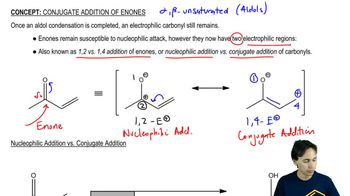
Electrophilic addition is a fundamental reaction mechanism in organic chemistry where an electrophile reacts with a nucleophile, resulting in the formation of a more saturated product. In the context of halogenation, the electrophile (Br2) adds across a double bond, leading to the formation of a bromonium ion intermediate, which is then attacked by a nucleophile, such as methanol in this case.
Recommended video:
Guided course
09:23
1,2 vs 1,4 Addition

Nucleophilic Attack

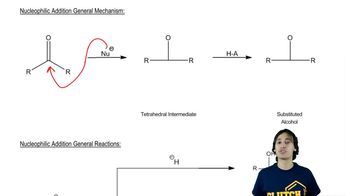
Nucleophilic attack refers to the process where a nucleophile donates an electron pair to an electrophile, forming a new bond. In the reaction shown, methanol acts as a nucleophile that attacks the bromonium ion intermediate formed after the initial addition of Br2, resulting in the substitution of a bromine atom with a methoxy group (OCH3).
Recommended video:
Guided course
08:27
Nucleophilic Addition

Regioselectivity

Regioselectivity is the preference of a chemical reaction to yield one structural isomer over others when multiple possibilities exist. In the halogenation of alkenes, the regioselectivity is influenced by the stability of the intermediates formed during the reaction. In this case, the methanol's attack on the more stable carbocation leads to the formation of a specific product with distinct substituents.
Recommended video:
Guided course
05:09
Heck Reaction