Ch. 19 - More About Amines • Reactions of Heterocyclic Compounds
Bruice - Organic Chemistry 8th Edition
Bruice8th EditionOrganic ChemistryISBN: 9780135213711Not the one you use?Change textbook
Chapter 20, Problem 37

Propose a mechanism for the following reaction:

Verified step by step guidance
1
Identify the functional groups present in the reactants and the type of reaction that is likely to occur. Consider common reaction mechanisms such as nucleophilic substitution, elimination, or addition.
Determine the most likely site of reactivity in the molecule. Look for electrophilic centers that might attract nucleophiles or vice versa.
Propose the first step of the mechanism, which often involves the formation of a reactive intermediate. This could be the attack of a nucleophile on an electrophile, leading to the formation of a new bond.
Consider any rearrangements or shifts that might occur after the initial step. This could involve carbocation rearrangements, shifts of hydrogens or alkyl groups, or the formation of double bonds.
Conclude the mechanism by showing how the final product is formed from the intermediate. Ensure that all atoms are accounted for and that the charges are balanced throughout the mechanism.

Verified video answer for a similar problem:

This video solution was recommended by our tutors as helpful for the problem above.
Video duration:
13m
Was this helpful?

Key Concepts

Here are the essential concepts you must grasp in order to answer the question correctly.

Reaction Mechanism

A reaction mechanism is a step-by-step description of how a chemical reaction occurs at the molecular level. It outlines the sequence of elementary steps, including bond breaking and formation, and the intermediates formed during the reaction. Understanding the mechanism is crucial for predicting the products and the conditions under which the reaction occurs.
Recommended video:
Guided course
02:16
Heck Reaction Mechanism

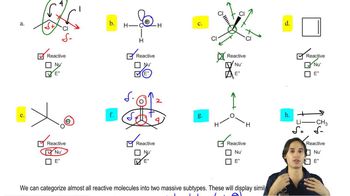
Nucleophiles and Electrophiles

Nucleophiles are species that donate an electron pair to form a chemical bond, while electrophiles are electron-deficient species that accept an electron pair. Identifying these species in a reaction is essential for proposing a mechanism, as it helps to determine the flow of electrons and the formation of new bonds during the reaction.
Recommended video:
Guided course
03:
Nucleophile or Electrophile

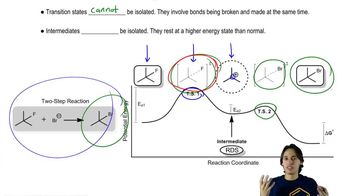
Transition States and Intermediates

Transition states are high-energy states that occur during the transformation from reactants to products, representing the point of maximum energy along the reaction pathway. Intermediates are species that are formed and consumed during the reaction but are not present in the final products. Understanding these concepts is vital for accurately depicting the mechanism and predicting the reaction's rate and outcome.
Recommended video:
Guided course
06:55
Intermediates vs. Transition States