Ch. 19 - More About Amines • Reactions of Heterocyclic Compounds
Bruice - Organic Chemistry 8th Edition
Bruice8th EditionOrganic ChemistryISBN: 9780135213711Not the one you use?Change textbook
Chapter 20, Problem 40f

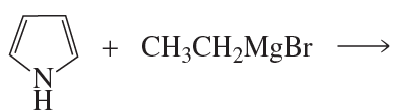
What is the major product of the following reactions?
f. Chemical reaction showing a nitrogen-containing compound reacting with ethylmagnesium bromide, leading to a major product.

Verified step by step guidance
1
Step 1: Analyze the reactants. The first reactant is pyrrole, a five-membered aromatic ring containing nitrogen with a hydrogen attached to it. The second reactant is cyclopentyl lithium, which is an organolithium compound and acts as a strong base.
Step 2: Consider the reactivity of pyrrole. Pyrrole is acidic due to the hydrogen attached to the nitrogen atom. The nitrogen atom is sp2 hybridized, and the lone pair on nitrogen is delocalized into the aromatic ring, making the N-H bond acidic.
Step 3: Predict the interaction between cyclopentyl lithium and pyrrole. Cyclopentyl lithium, being a strong base, will deprotonate the pyrrole at the nitrogen atom, removing the hydrogen and forming a lithium salt of pyrrole.
Step 4: Write the intermediate product. After deprotonation, the product will be the pyrrole anion (C4H4N⁻) with lithium (Li⁺) as the counterion. This is a lithium pyrrolide salt.
Step 5: Consider the stability of the product. The pyrrole anion is stabilized by resonance, as the negative charge on nitrogen can delocalize into the aromatic ring. This makes the lithium pyrrolide salt the major product of the reaction.

Verified video answer for a similar problem:

This video solution was recommended by our tutors as helpful for the problem above.
Video duration:
5m
Was this helpful?

Key Concepts

Here are the essential concepts you must grasp in order to answer the question correctly.

Nucleophilicity

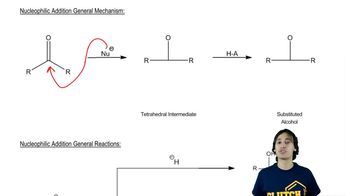
Nucleophilicity refers to the ability of a species to donate an electron pair to form a chemical bond. In organic reactions, nucleophiles are typically negatively charged or neutral species with lone pairs of electrons. Understanding nucleophilicity is crucial for predicting the outcome of reactions, as it determines how readily a nucleophile will attack an electrophile.
Recommended video:
Guided course
08:27
Nucleophilic Addition

Electrophilic Addition

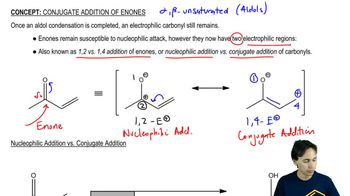
Electrophilic addition is a fundamental reaction mechanism in organic chemistry where an electrophile reacts with a nucleophile to form a new bond. This process often occurs in alkenes and alkynes, where the double or triple bond acts as a nucleophile. Recognizing the electrophilic sites in a molecule helps in determining the major product of the reaction.
Recommended video:
Guided course
09:23
1,2 vs 1,4 Addition

Regioselectivity

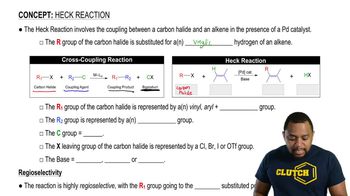
Regioselectivity is the preference of a chemical reaction to yield one structural isomer over others when multiple products are possible. In reactions involving unsymmetrical reagents or substrates, understanding regioselectivity is essential for predicting which product will be formed. This concept is particularly important in reactions involving nucleophiles and electrophiles, as it influences the distribution of products.
Recommended video:
Guided course
05:09
Heck Reaction