Ch. 19 - More About Amines • Reactions of Heterocyclic Compounds
Bruice - Organic Chemistry 8th Edition
Bruice8th EditionOrganic ChemistryISBN: 9780135213711Not the one you use?Change textbook
Chapter 20, Problem 40d

What is the major product of the following reactions?
d.

Verified step by step guidance
1
Step 1: Analyze the reactants. The starting material is a pyridone (a six-membered aromatic ring containing nitrogen and a ketone group). The reagent is phosphorus trichloride (PCl₃), which is commonly used for chlorination reactions.
Step 2: Understand the role of PCl₃. Phosphorus trichloride can act as a chlorinating agent, replacing the oxygen atom in the carbonyl group with a chlorine atom. This reaction typically proceeds via the formation of an intermediate where PCl₃ interacts with the carbonyl oxygen.
Step 3: Predict the mechanism. The lone pair on the oxygen of the carbonyl group attacks the phosphorus atom in PCl₃, forming a bond. This leads to the elimination of one chloride ion and the formation of a reactive intermediate.
Step 4: Consider the final product. The intermediate undergoes further reaction, resulting in the replacement of the carbonyl oxygen with a chlorine atom. The major product is likely to be a chlorinated pyridine derivative.
Step 5: Verify aromaticity. After the substitution, the aromaticity of the pyridine ring is preserved, as the reaction does not disrupt the conjugated π-electron system of the ring.

Verified video answer for a similar problem:

This video solution was recommended by our tutors as helpful for the problem above.
Video duration:
2m
Was this helpful?

Key Concepts

Here are the essential concepts you must grasp in order to answer the question correctly.

Reaction Mechanisms

Understanding reaction mechanisms is crucial in organic chemistry as they describe the step-by-step process by which reactants transform into products. This includes identifying intermediates, transition states, and the movement of electrons. Familiarity with mechanisms helps predict the major products of reactions based on the stability of intermediates and the energy changes involved.
Recommended video:
Guided course
02:16
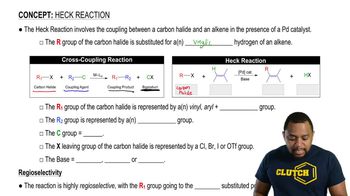
Heck Reaction Mechanism

Functional Groups

Functional groups are specific groups of atoms within molecules that are responsible for the characteristic chemical reactions of those molecules. Recognizing functional groups allows chemists to predict how a compound will react in a given reaction. The presence of certain functional groups can influence the reactivity and the type of products formed in organic reactions.
Recommended video:
Guided course
02:36
Identifying Functional Groups

Regioselectivity and Stereoselectivity

Regioselectivity refers to the preference of a chemical reaction to yield one structural isomer over others, while stereoselectivity involves the preference for one stereoisomer over another. These concepts are essential for predicting the major product in reactions, as they determine how reactants will orient and react, leading to specific products based on the reaction conditions and mechanisms.
Recommended video:
Guided course
05:09
Heck Reaction