Ch. 19 - More About Amines • Reactions of Heterocyclic Compounds
Bruice - Organic Chemistry 8th Edition
Bruice8th EditionOrganic ChemistryISBN: 9780135213711Not the one you use?Change textbook
Chapter 20, Problem 32a,b

What products are obtained when the following tertiary amines react with hydrogen peroxide followed by heat?
a.
b.

Verified step by step guidance
1
Step 1: Recognize the reaction type. The reaction involves tertiary amines reacting with hydrogen peroxide followed by heat. This is known as the Cope elimination reaction, where tertiary amines are oxidized to amine oxides, which then undergo elimination to form alkenes.
Step 2: Analyze the structure of the first compound (a). The tertiary amine has the structure (CH3)2NCH2CH2CH3. Upon reaction with hydrogen peroxide, the nitrogen atom is oxidized to form an amine oxide. The heat then induces elimination, leading to the formation of an alkene.
Step 3: Predict the elimination product for compound (a). The elimination occurs via a syn-elimination mechanism, where the hydrogen atom on the β-carbon (adjacent to the nitrogen) and the leaving group (oxygen bonded to nitrogen) are removed. This results in the formation of an alkene between the α and β carbons.
Step 4: Analyze the structure of the second compound (b). The tertiary amine has the structure CH3NCH2CH2CH3 with a phenyl group attached to the nitrogen. Similar to compound (a), the nitrogen is oxidized to an amine oxide, and heat induces elimination to form an alkene.
Step 5: Predict the elimination product for compound (b). The elimination follows the same syn-elimination mechanism. The phenyl group remains intact, and the alkene forms between the α and β carbons adjacent to the nitrogen. The product will be a phenyl-substituted alkene.

Verified video answer for a similar problem:

This video solution was recommended by our tutors as helpful for the problem above.
Video duration:
5m
Was this helpful?

Key Concepts

Here are the essential concepts you must grasp in order to answer the question correctly.

Tertiary Amines

Tertiary amines are organic compounds that contain a nitrogen atom bonded to three carbon atoms. They are characterized by their ability to act as nucleophiles due to the lone pair of electrons on the nitrogen. Understanding their structure and reactivity is crucial for predicting the products of reactions, especially with oxidizing agents like hydrogen peroxide.
Recommended video:
Guided course
01:57
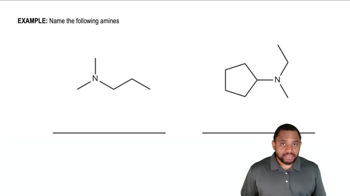
Naming Secondary and Tertiary Amines

Hydrogen Peroxide as an Oxidizing Agent

Hydrogen peroxide (H2O2) is a powerful oxidizing agent that can facilitate various chemical reactions, including the oxidation of amines. In the context of tertiary amines, it can lead to the formation of N-oxides, which are important intermediates in organic synthesis. Recognizing the role of hydrogen peroxide in these reactions is essential for predicting the outcome.
Recommended video:
Guided course
03:40
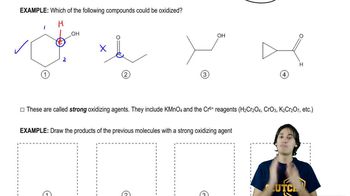
Strong oxidizing agents

Thermal Decomposition of N-Oxides

When N-oxides are subjected to heat, they can undergo thermal decomposition, leading to the formation of various products, including alkenes and other nitrogen-containing compounds. This process is significant in understanding the final products of the reaction between tertiary amines and hydrogen peroxide, as heat can drive the reaction towards specific pathways.
Recommended video:
Guided course
06:36
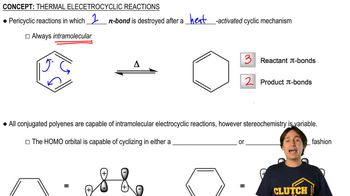
MO Theory of Thermal Electrocyclics