Ch. 19 - More About Amines • Reactions of Heterocyclic Compounds
Bruice - Organic Chemistry 8th Edition
Bruice8th EditionOrganic ChemistryISBN: 9780135213711Not the one you use?Change textbook
Chapter 20, Problem 32d

What products are obtained when the following tertiary amines react with hydrogen peroxide followed by heat?
d. Chemical structure of a tertiary amine with a nitrogen atom bonded to three carbon groups, including a cyclohexane ring.

Verified step by step guidance
1
Step 1: Recognize the structure of the given compound. The molecule is a tertiary amine with a nitrogen atom bonded to three alkyl groups: an ethyl group, a methyl group, and a cyclohexyl group.
Step 2: Understand the reaction mechanism. When tertiary amines react with hydrogen peroxide (H₂O₂), the nitrogen undergoes oxidation to form an amine oxide. This is a nucleophilic substitution reaction where the lone pair on nitrogen attacks the oxygen of H₂O₂.
Step 3: After the formation of the amine oxide, heating the compound leads to a Cope elimination reaction. In this reaction, the amine oxide undergoes a syn-elimination to produce an alkene and a hydroxylamine.
Step 4: Identify the possible products of the Cope elimination. The elimination occurs in such a way that the hydrogen atom and the leaving group (amine oxide) are removed from adjacent carbon atoms, forming a double bond in the cyclohexane ring.
Step 5: Predict the final products. The major product will be the alkene formed in the cyclohexane ring, and the hydroxylamine (CH₂CH₃-N-OH) will be the byproduct. The position of the double bond in the cyclohexane ring depends on the stereochemistry and the most stable configuration.

Verified video answer for a similar problem:

This video solution was recommended by our tutors as helpful for the problem above.
Video duration:
9m
Was this helpful?

Key Concepts

Here are the essential concepts you must grasp in order to answer the question correctly.

Tertiary Amines

Tertiary amines are organic compounds that contain a nitrogen atom bonded to three carbon-containing groups. They are characterized by their ability to act as bases and nucleophiles due to the lone pair of electrons on the nitrogen. In reactions, tertiary amines can undergo oxidation, which is relevant when considering their behavior in the presence of oxidizing agents like hydrogen peroxide.
Recommended video:
Guided course
01:57
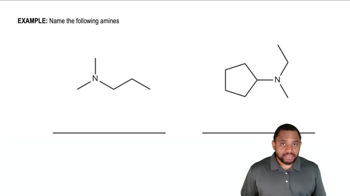
Naming Secondary and Tertiary Amines

Hydrogen Peroxide as an Oxidizing Agent

Hydrogen peroxide (H2O2) is a powerful oxidizing agent that can facilitate various chemical reactions, including the oxidation of amines. When tertiary amines react with hydrogen peroxide, they can form N-oxides, which are important intermediates in organic synthesis. Understanding this reaction is crucial for predicting the products formed when heat is applied.
Recommended video:
Guided course
03:40
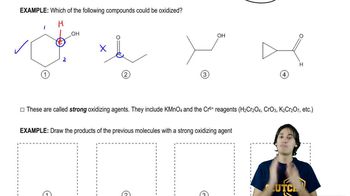
Strong oxidizing agents

Cope Elimination

Cope elimination is a reaction mechanism that involves the elimination of a leaving group from a tertiary amine, typically resulting in the formation of an alkene. This process often occurs under heat and can lead to the generation of double bonds in the product. Recognizing the conditions that favor Cope elimination is essential for predicting the final products of the reaction involving the tertiary amine and hydrogen peroxide.
Recommended video:
Guided course
06:28
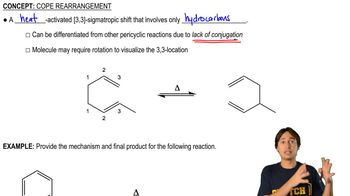
Definition of Cope Rearrangement