Butyric acid, the compound responsible for the unpleasant odor and taste of sour milk, has a pKa value of 4.82. What is its Ka value? Is it a stronger acid or a weaker acid than vitamin C?
Ch. 2 - Acids and Bases: Central to Understanding Organic Chemistry
All textbooks
Bruice 8th Edition
Ch. 2 - Acids and Bases: Central to Understanding Organic Chemistry
Problem 5ab
Bruice 8th Edition
Ch. 2 - Acids and Bases: Central to Understanding Organic Chemistry
Problem 5abChapter 3, Problem 5ab
a. Which is a stronger acid: one with a pKa of 5.2 or one with a pKa of 5.8?
b. Which is a stronger acid: one with an acid dissociation constant of 3.4 × 10⁻³ or one with an acid dissociation constant of 2.1 × 10⁻⁴?
Verified step by step guidance1
Step 1: Understand the relationship between pKa and acid strength. The lower the pKa value, the stronger the acid. This is because pKa is inversely related to the acid dissociation constant (Ka), which measures the extent of ionization of the acid in solution.
Step 2: Compare the pKa values given in part (a). The acid with a pKa of 5.2 is lower than the acid with a pKa of 5.8, indicating that the acid with a pKa of 5.2 is stronger.
Step 3: Understand the relationship between Ka and acid strength for part (b). The higher the Ka value, the stronger the acid. This is because a larger Ka indicates greater ionization of the acid in solution.
Step 4: Compare the Ka values given in part (b). The acid with a Ka of 3.4×10⁻³ is larger than the acid with a Ka of 2.1×10⁻⁴, indicating that the acid with a Ka of 3.4×10⁻³ is stronger.
Step 5: Summarize the findings: For part (a), the acid with a pKa of 5.2 is stronger. For part (b), the acid with a Ka of 3.4×10⁻³ is stronger. This demonstrates the inverse relationship between pKa and Ka when determining acid strength.

Verified video answer for a similar problem:
This video solution was recommended by our tutors as helpful for the problem above.
Video duration:
4mWas this helpful?
Key Concepts
Here are the essential concepts you must grasp in order to answer the question correctly.
pKa and Acid Strength
The pKa value is a logarithmic measure of the acidity of a substance, where a lower pKa indicates a stronger acid. This is because pKa is derived from the acid dissociation constant (Ka), which quantifies the extent to which an acid donates protons in solution. Therefore, comparing pKa values allows us to determine which acid is stronger based on their numerical values.
Recommended video:
Guided course
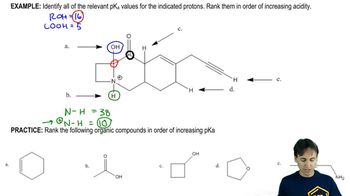
Identifying pKa values
Acid Dissociation Constant (Ka)
The acid dissociation constant (Ka) is a quantitative measure of the strength of an acid in solution. It represents the equilibrium constant for the dissociation of an acid into its conjugate base and a proton. A larger Ka value indicates a stronger acid, as it signifies a greater tendency to lose protons, making it essential for comparing acid strengths directly.
Recommended video:
Guided course
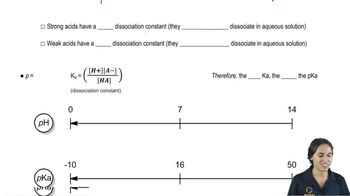
The relationship between equilibrium constant and pKa.
Relationship Between pKa and Ka
The relationship between pKa and Ka is expressed by the equation pKa = -log(Ka). This means that as the Ka increases, the pKa decreases, reinforcing the idea that stronger acids have lower pKa values. Understanding this relationship is crucial for interpreting acid strength comparisons, as it allows for the conversion between the two measures and aids in determining which acid is stronger.
Recommended video:
Guided course
The relationship between equilibrium constant and pKa.
Related Practice
Textbook Question
932
views
Textbook Question
What is the conjugate base of each of the following?
1. NH3
2. HBr
3. HNO3
4. H2O
1389
views
Textbook Question
Antacids are compounds that neutralize stomach acid. Write the equations that show how Milk of Magnesia, Alka-Seltzer, and Tums remove excess acid.
a. Milk of Magnesia: Mg(OH)2
b. Alka-Seltzer: KHCO3 and NaHCO3
c. Tums: CaCO3
2410
views
Textbook Question
What is the conjugate acid of each of the following?
1. NH3
2. Cl−
3. HO−
4. H2O
1887
views
Textbook Question
An acid has a Ka of 4.53 × 10⁻⁶ in water. What is its Keq for reaction with water in a dilute solution? ([H2O] = 55.5 M)
1574
views
Textbook Question
Consider the following reaction:
HBr + -C≡N ⇌ Br− + HC≡N
g. What is the conjugate base of the acid on the right?
h. What is the conjugate acid of the base on the right?
1201
views