Ch. 2 - Acids and Bases: Central to Understanding Organic Chemistry
Bruice - Organic Chemistry 8th Edition
Bruice8th EditionOrganic ChemistryISBN: 9780135213711Not the one you use?Change textbook
Chapter 3, Problem 8a

Antacids are compounds that neutralize stomach acid. Write the equations that show how Milk of Magnesia, Alka-Seltzer, and Tums remove excess acid.
a. Milk of Magnesia: Mg(OH)2
b. Alka-Seltzer: KHCO3 and NaHCO3
c. Tums: CaCO3

Verified step by step guidance
1
Step 1: Understand the problem. The question asks for the chemical equations that show how the active ingredients in Milk of Magnesia, Alka-Seltzer, and Tums neutralize stomach acid (HCl). Neutralization reactions involve an acid (HCl) reacting with a base to form water and a salt (or other products).
Step 2: Write the equation for Milk of Magnesia (Mg(OH)2). Magnesium hydroxide reacts with hydrochloric acid (HCl) in a 1:2 molar ratio. The reaction is: Mg(OH)2+2HClMgCl2+2H2O.
Step 3: Write the equation for Alka-Seltzer (KHCO3 and NaHCO3). Both potassium bicarbonate and sodium bicarbonate react with HCl in a 1:1 molar ratio to produce carbon dioxide (CO2), water (H2O), and a salt. For KHCO3: KHCO3+HClKCl+H2O+CO2. For NaHCO3: NaHCO3+HClNaCl+H2O+CO2.
Step 4: Write the equation for Tums (CaCO3). Calcium carbonate reacts with HCl in a 1:2 molar ratio to produce calcium chloride (CaCl2), water (H2O), and carbon dioxide (CO2). The reaction is: CaCO3+2HClCaCl2+H2O+CO2.
Step 5: Summarize the reactions. Each antacid neutralizes stomach acid by reacting with HCl to form water, a salt, and sometimes carbon dioxide. These reactions reduce the acidity in the stomach, providing relief from symptoms like heartburn.

Verified video answer for a similar problem:

This video solution was recommended by our tutors as helpful for the problem above.
Video duration:
6m
Was this helpful?

Key Concepts

Here are the essential concepts you must grasp in order to answer the question correctly.

Acid-Base Neutralization

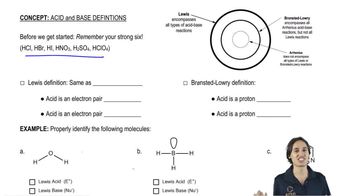
Acid-base neutralization is a chemical reaction where an acid reacts with a base to produce water and a salt. In the context of antacids, the base component of the antacid reacts with hydrochloric acid (HCl) in the stomach, effectively reducing acidity. This reaction is crucial for understanding how antacids alleviate symptoms of heartburn and indigestion.
Recommended video:
Guided course
02:49
The Lewis definition of acids and bases.

Chemical Equations

Chemical equations represent the reactants and products in a chemical reaction using their chemical formulas. For antacids, writing balanced equations shows how each compound interacts with stomach acid. Understanding how to balance these equations is essential for accurately depicting the stoichiometry of the neutralization reactions.
Recommended video:
3:11
Chemical Reactions of Phosphate Anhydrides Concept 1

Common Antacid Compounds

Common antacid compounds include magnesium hydroxide (Mg(OH)2), potassium bicarbonate (KHCO3), sodium bicarbonate (NaHCO3), and calcium carbonate (CaCO3). Each of these compounds has a specific mechanism for neutralizing stomach acid, and knowing their chemical properties helps in predicting the outcomes of their reactions with HCl. This knowledge is vital for writing the correct chemical equations for each antacid.
Recommended video:
Guided course
01:40
Defining meso compounds.