Ch. 20 - The Organic Chemistry of Carbohydrates
Bruice - Organic Chemistry 8th Edition
Bruice8th EditionOrganic ChemistryISBN: 9780135213711Not the one you use?Change textbook
Chapter 21, Problem 14a,b

a. Name an aldohexose other than D-glucose that is oxidized to D-glucaric acid by nitric acid.
b. What is another name for D-glucaric acid?

Verified step by step guidance
1
Step 1: Understand the problem. Part (a) asks for an aldohexose (a six-carbon sugar with an aldehyde group) other than D-glucose that can be oxidized to D-glucaric acid by nitric acid. Part (b) asks for an alternative name for D-glucaric acid.
Step 2: Recall the oxidation process. Nitric acid oxidizes both the aldehyde group at the C-1 position and the primary alcohol group at the C-6 position of an aldohexose to carboxylic acids, forming a dicarboxylic acid. This reaction is characteristic of aldohexoses.
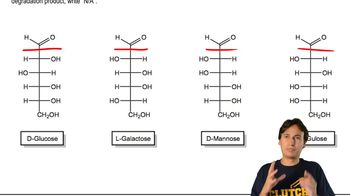
Step 3: Identify another aldohexose. Besides D-glucose, other aldohexoses include D-mannose and D-galactose. These sugars also have the structural features necessary for oxidation by nitric acid to form dicarboxylic acids.
Step 4: Provide the alternative name for D-glucaric acid. D-glucaric acid is also known as saccharic acid. This name is derived from its relationship to sugars (saccharides).
Step 5: Summarize the findings. For part (a), D-mannose or D-galactose can be oxidized to D-glucaric acid by nitric acid. For part (b), the alternative name for D-glucaric acid is saccharic acid.

Verified video answer for a similar problem:

This video solution was recommended by our tutors as helpful for the problem above.
Video duration:
5m
Was this helpful?

Key Concepts

Here are the essential concepts you must grasp in order to answer the question correctly.

Aldohexoses

Aldohexoses are six-carbon sugars that contain an aldehyde group. They are a subclass of monosaccharides characterized by their structure, which includes a carbonyl group at the first carbon and hydroxyl groups on the remaining carbons. Examples include glucose, galactose, and mannose. Understanding their structure is essential for recognizing their reactivity and potential oxidation products.
Recommended video:
Guided course
02:29
Which aldohexoses produce the same Wohl Degradation product

Oxidation of Sugars

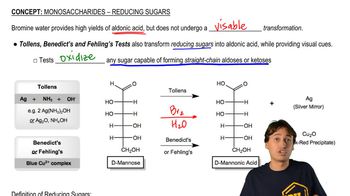
The oxidation of sugars involves the conversion of alcohol groups into carbonyl groups or carboxylic acids. In the case of aldohexoses, nitric acid can oxidize the aldehyde group and the primary alcohol group at the end of the sugar chain, leading to the formation of d-glucaric acid. This process is significant in organic chemistry as it illustrates the reactivity of carbohydrates and their transformation into different functional groups.
Recommended video:
Guided course
08:42
Reducing Sugars

D-Glucaric Acid

D-glucaric acid, also known as saccharic acid, is a dicarboxylic acid derived from the oxidation of aldohexoses. It contains two carboxylic acid groups, which result from the oxidation of both the aldehyde and the terminal alcohol of the sugar. This compound is important in biochemistry and can be involved in various metabolic pathways, making it relevant for understanding sugar metabolism and its derivatives.
Recommended video:
Guided course
06:47
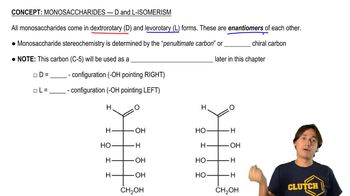
Monosaccharides - D and L Isomerism