Ch. 20 - The Organic Chemistry of Carbohydrates
Bruice - Organic Chemistry 8th Edition
Bruice8th EditionOrganic ChemistryISBN: 9780135213711Not the one you use?Change textbook
Chapter 21, Problem 14c

Name another pair of aldohexoses that are oxidized to identical aldaric acids.

Verified step by step guidance
1
Understand the problem: Aldohexoses are six-carbon sugars with an aldehyde group. When oxidized, both the aldehyde group at C-1 and the primary alcohol group at C-6 are converted into carboxylic acids, forming aldaric acids. The task is to identify a pair of aldohexoses that yield the same aldaric acid upon oxidation.
Recall the concept of stereoisomers: Aldohexoses can have different configurations at their chiral centers (C-2, C-3, C-4, and C-5). Two aldohexoses that differ only in the configuration of their non-terminal chiral centers (C-2, C-3, C-4, or C-5) are called epimers. Epimers at C-2, C-3, or C-4 can sometimes yield the same aldaric acid upon oxidation.
Identify the key property: When oxidized, the stereochemistry at the non-terminal chiral centers (C-2, C-3, C-4, and C-5) determines whether two aldohexoses produce the same aldaric acid. If the stereochemistry of the two sugars is symmetric about the central carbon (C-3), they will yield the same aldaric acid.
Apply the concept to specific aldohexoses: For example, D-mannose and D-gulose are epimers at C-2 and C-3, respectively. Their stereochemistry is symmetric about C-3, so they are oxidized to the same aldaric acid.
Verify the result: Draw the Fischer projections of the two aldohexoses and their corresponding aldaric acid. Confirm that the aldaric acid has identical stereochemistry regardless of which aldohexose is oxidized.

Verified video answer for a similar problem:

This video solution was recommended by our tutors as helpful for the problem above.
Video duration:
4m
Was this helpful?

Key Concepts

Here are the essential concepts you must grasp in order to answer the question correctly.

Aldohexoses

Aldohexoses are six-carbon sugars that contain an aldehyde group. They are a subclass of monosaccharides and include common sugars like glucose and galactose. The structure of aldohexoses allows them to undergo various chemical reactions, including oxidation, which is crucial for understanding their reactivity and transformations.
Recommended video:
Guided course
02:29
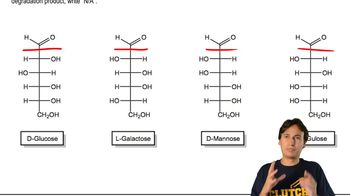
Which aldohexoses produce the same Wohl Degradation product

Oxidation of Sugars

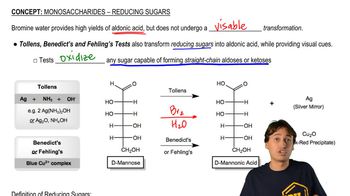
Oxidation in organic chemistry refers to the process where a molecule loses electrons, often involving the conversion of an aldehyde group to a carboxylic acid. In the context of aldohexoses, this reaction can lead to the formation of aldaric acids, which are dicarboxylic acids derived from the oxidation of both the aldehyde and the primary alcohol groups present in the sugar.
Recommended video:
Guided course
08:42
Reducing Sugars

Aldaric Acids

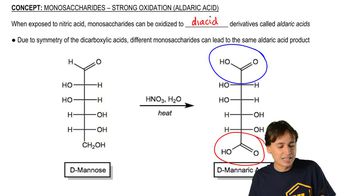
Aldaric acids are dicarboxylic acids formed from the oxidation of both the aldehyde and the terminal alcohol functional groups of aldohexoses. They have the general formula HOOC-(CHOH)n-COOH, where n is the number of carbon atoms between the two carboxylic acid groups. Identifying pairs of aldohexoses that yield the same aldaric acid upon oxidation is essential for understanding their structural similarities and reactivity.
Recommended video:
Guided course
03:10
Monosaccharides - Strong Oxidation (Aldaric Acid)