Ch. 20 - The Organic Chemistry of Carbohydrates
Bruice - Organic Chemistry 8th Edition
Bruice8th EditionOrganic ChemistryISBN: 9780135213711Not the one you use?Change textbook
Chapter 21, Problem 16b

What two monosaccharides can be degraded to
b. D-arabinose? 

Verified step by step guidance
1
Understand the problem: The question is asking which two monosaccharides can be degraded to D-arabinose. This involves identifying monosaccharides that, when subjected to a degradation reaction (such as Ruff degradation), yield D-arabinose as a product.
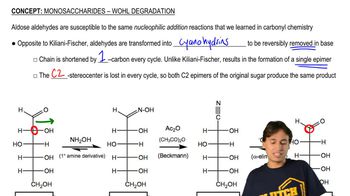
Recall the Ruff degradation process: Ruff degradation is a reaction that shortens the carbon chain of an aldose by one carbon atom. It involves oxidation of the aldose to an aldonic acid, followed by decarboxylation to produce a shorter aldose.
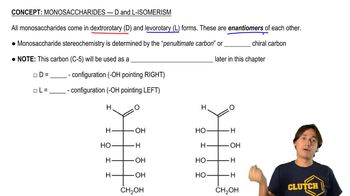
Identify the structure of D-arabinose: D-arabinose is a five-carbon aldose sugar (C₅H₁₀O₅) with the following stereochemistry: the hydroxyl groups on carbons 2 and 3 are on the right, and the hydroxyl group on carbon 4 is on the left in a Fischer projection.
Determine the possible precursors: To obtain D-arabinose via Ruff degradation, the precursor monosaccharides must be six-carbon aldoses (hexoses) that, when shortened by one carbon, yield the structure of D-arabinose. Analyze the stereochemistry of potential candidates such as D-glucose and D-mannose.
Verify the stereochemical relationship: Confirm that the Ruff degradation of D-glucose and D-mannose leads to D-arabinose by examining the stereochemical changes during the reaction. Both D-glucose and D-mannose are valid precursors because their structures align with the stereochemistry of D-arabinose after the loss of one carbon.

Verified video answer for a similar problem:

This video solution was recommended by our tutors as helpful for the problem above.
Video duration:
5m
Was this helpful?

Key Concepts

Here are the essential concepts you must grasp in order to answer the question correctly.

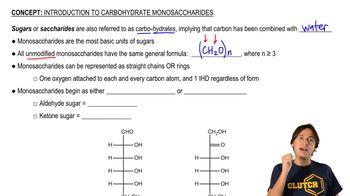
Monosaccharides

Monosaccharides are the simplest form of carbohydrates, consisting of single sugar molecules like glucose, fructose, and galactose. They serve as the building blocks for more complex carbohydrates, such as disaccharides and polysaccharides. Understanding their structure and properties is essential for analyzing carbohydrate metabolism and degradation.
Recommended video:
Guided course
12:01
Monosaccharide

Degradation Pathways

Degradation pathways refer to the biochemical processes through which complex molecules are broken down into simpler ones, often releasing energy. In the context of carbohydrates, this includes glycolysis and other metabolic pathways that convert monosaccharides into usable energy forms. Recognizing these pathways is crucial for understanding how monosaccharides like d-arabinose are utilized in biological systems.
Recommended video:
Guided course
09:43
Monosaccharides - Wohl Degradation

D-Arabinose

D-arabinose is a five-carbon aldopentose sugar that plays a role in various biological processes. It is a component of certain polysaccharides and is involved in the metabolism of nucleic acids. Identifying the monosaccharides that can be degraded to d-arabinose requires knowledge of its structural characteristics and the enzymatic reactions that facilitate its conversion from other sugars.
Recommended video:
Guided course
06:47
Monosaccharides - D and L Isomerism