Ch. 21 - Amino Acids, Peptides, and Proteins
Bruice - Organic Chemistry 8th Edition
Bruice8th EditionOrganic ChemistryISBN: 9780135213711Not the one you use?Change textbook
Chapter 22, Problem 26

Draw the tetrapeptide Ala-Thr-Asp-Asn and indicate the peptide bonds.

Verified step by step guidance
1
Step 1: Understand the structure of each amino acid. Alanine (Ala) has a methyl group (-CH₃) as its side chain, Threonine (Thr) has a hydroxyl group (-CH(OH)CH₃), Aspartic acid (Asp) has a carboxylic acid group (-CH₂COOH), and Asparagine (Asn) has an amide group (-CH₂CONH₂).
Step 2: Identify the general structure of an amino acid. Each amino acid has an amino group (-NH₂), a carboxyl group (-COOH), a hydrogen atom, and a unique side chain (R group) attached to the central carbon (α-carbon).
Step 3: Link the amino acids in the specified order (Ala-Thr-Asp-Asn) by forming peptide bonds. A peptide bond is formed between the carboxyl group (-COOH) of one amino acid and the amino group (-NH₂) of the next amino acid, releasing a molecule of water (H₂O) in a condensation reaction.
Step 4: Draw the tetrapeptide structure. Start with Alanine, connect its carboxyl group to the amino group of Threonine via a peptide bond, then connect Threonine's carboxyl group to the amino group of Aspartic acid, and finally connect Aspartic acid's carboxyl group to the amino group of Asparagine. Ensure the side chains of each amino acid are correctly represented.
Step 5: Indicate the peptide bonds in the structure. Highlight the C=O and N-H bonds that form the peptide linkages between each pair of amino acids. These bonds are the defining feature of the peptide backbone.

Verified video answer for a similar problem:

This video solution was recommended by our tutors as helpful for the problem above.
Video duration:
6m
Was this helpful?

Key Concepts

Here are the essential concepts you must grasp in order to answer the question correctly.

Peptide Bonds

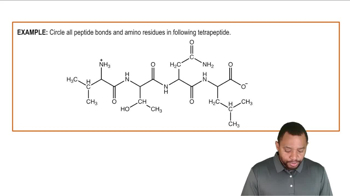
Peptide bonds are covalent bonds that link amino acids together in a protein or peptide chain. They form through a dehydration synthesis reaction, where the carboxyl group of one amino acid reacts with the amino group of another, releasing a molecule of water. This bond is crucial for the structure of proteins, as it determines the sequence and arrangement of amino acids.
Recommended video:
1:24
Peptides Example 1

Amino Acids

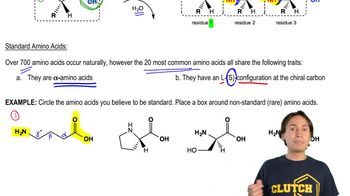
Amino acids are the building blocks of proteins, each consisting of a central carbon atom, an amino group, a carboxyl group, a hydrogen atom, and a variable side chain (R group). The side chain determines the properties of each amino acid, influencing the overall structure and function of the resulting peptide or protein. In the context of the question, the specific amino acids Ala (Alanine), Thr (Threonine), Asp (Aspartic acid), and Asn (Asparagine) are to be represented.
Recommended video:
Guided course
09:36
Standard Amino Acids

Tetrapeptide Structure

A tetrapeptide is a peptide composed of four amino acids linked by peptide bonds. The sequence of amino acids in a tetrapeptide is significant, as it dictates the peptide's properties and biological function. In this case, the tetrapeptide Ala-Thr-Asp-Asn must be drawn to show the correct order and connections, highlighting the peptide bonds between each pair of amino acids.
Recommended video:
Guided course
03:04
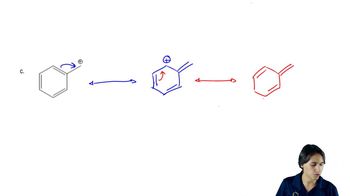
Drawing Resonance Structures