Ch. 21 - Amino Acids, Peptides, and Proteins
Bruice - Organic Chemistry 8th Edition
Bruice8th EditionOrganic ChemistryISBN: 9780135213711Not the one you use?Change textbook
Chapter 22, Problem 28

Which bonds in the backbone of a peptide can rotate freely?

Verified step by step guidance
1
Understand the structure of a peptide backbone: A peptide backbone consists of repeating units of amide bonds (-CONH-) connecting amino acids. The backbone includes the alpha carbon (Cα), the carbonyl carbon (C=O), and the amide nitrogen (N-H).
Recognize the rigidity of the peptide bond: The peptide bond itself (between the carbonyl carbon and the amide nitrogen) is planar and rigid due to resonance, which gives it partial double-bond character. This means the peptide bond cannot rotate freely.
Identify the bonds adjacent to the peptide bond: The bonds that can rotate freely are the single bonds on either side of the peptide bond. These include the bond between the alpha carbon (Cα) and the carbonyl carbon (C=O), and the bond between the alpha carbon (Cα) and the amide nitrogen (N).
Understand the significance of phi (ϕ) and psi (ψ) angles: The rotation around the bond between the alpha carbon and the amide nitrogen is described by the phi (ϕ) angle, while the rotation around the bond between the alpha carbon and the carbonyl carbon is described by the psi (ψ) angle. These rotations allow for flexibility in the peptide backbone.
Note the constraints on rotation: While these bonds can rotate freely, steric hindrance and interactions between side chains and backbone atoms can limit the range of rotation in real peptide structures.

Verified video answer for a similar problem:

This video solution was recommended by our tutors as helpful for the problem above.
Video duration:
3m
Was this helpful?

Key Concepts

Here are the essential concepts you must grasp in order to answer the question correctly.

Peptide Bond

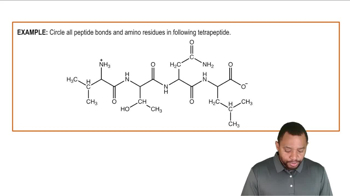
A peptide bond is a covalent bond formed between the carboxyl group of one amino acid and the amino group of another, resulting in the release of a water molecule. This bond is characterized by partial double-bond character due to resonance, which restricts its rotation and contributes to the rigidity of the peptide backbone.
Recommended video:
1:24
Peptides Example 1

Phi (φ) and Psi (ψ) Angles

In the context of peptide bonds, the phi (φ) and psi (ψ) angles refer to the torsional angles around the bonds connecting the nitrogen to the alpha carbon and the alpha carbon to the carbonyl carbon, respectively. These angles can rotate freely, allowing for the conformational flexibility of the peptide backbone, which is crucial for protein folding and function.
Recommended video:
Guided course
06:20
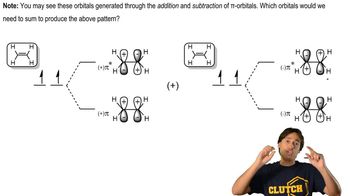
Alternative MO Notation for Dienes

Conformational Flexibility

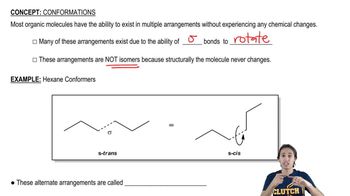
Conformational flexibility in peptides refers to the ability of the peptide chain to adopt various spatial arrangements due to the rotation around certain bonds. This flexibility is essential for the biological activity of proteins, as it enables them to change shape and interact with other molecules, facilitating processes such as enzyme catalysis and receptor binding.
Recommended video:
Guided course
03:29
Understanding what a conformer is.