Ch. 21 - Amino Acids, Peptides, and Proteins
Bruice - Organic Chemistry 8th Edition
Bruice8th EditionOrganic ChemistryISBN: 9780135213711Not the one you use?Change textbook
Chapter 22, Problem 18a

Explain the order of elution (with a buffer of pH 4) of the following pairs of amino acids through a column packed with Dowex 50:
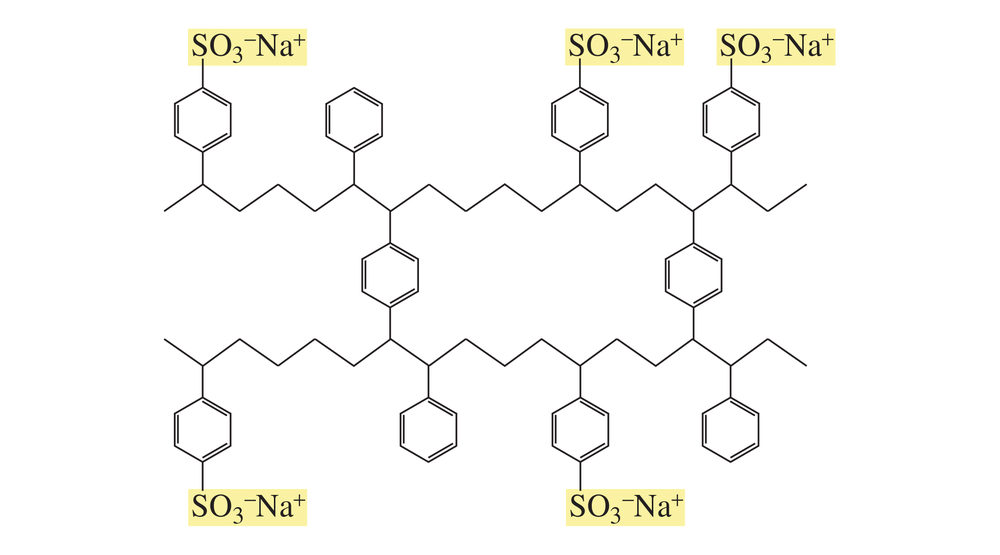
Chemical structure of Dowex 50 resin with highlighted sodium sulfonate groups, used in amino acid separation.
a. aspartate before serine

Verified step by step guidance
1
Understand the context: Dowex 50 is a cation-exchange resin, meaning it binds positively charged species (cations). The elution order of amino acids depends on their net charge at the given pH (pH 4 in this case). Amino acids with a more negative net charge will elute first because they interact less strongly with the resin.
Determine the pKa values of the relevant functional groups for each amino acid: Aspartate has a carboxylic acid side chain with a pKa around 3.9, while serine has a hydroxyl side chain, which is not ionizable under these conditions. Both amino acids also have an amino group (pKa ~9) and a carboxylic acid group (pKa ~2).
Calculate the net charge of each amino acid at pH 4: At pH 4, the carboxylic acid groups (pKa ~2) will be deprotonated (-1 charge), while the amino groups (pKa ~9) will remain protonated (+1 charge). For aspartate, the side chain carboxylic acid (pKa ~3.9) will also be partially deprotonated, contributing an additional negative charge. Serine, lacking an ionizable side chain, will have a net charge closer to neutral.
Compare the net charges: Aspartate will have a more negative net charge than serine at pH 4 due to its deprotonated side chain carboxylic acid. This means aspartate will interact less strongly with the cation-exchange resin and elute first.
Conclude the elution order: Based on their net charges at pH 4, aspartate will elute before serine from the Dowex 50 column.

Verified video answer for a similar problem:

This video solution was recommended by our tutors as helpful for the problem above.
Video duration:
2m
Was this helpful?

Key Concepts

Here are the essential concepts you must grasp in order to answer the question correctly.

Ion Exchange Chromatography

Ion exchange chromatography is a technique used to separate charged molecules based on their affinity to the charged stationary phase. In this method, amino acids are passed through a column containing charged resin, such as Dowex 50, which can attract and hold onto oppositely charged species. The order of elution depends on the charge of the amino acids at a given pH, influencing their interaction with the resin.
Recommended video:
3:39
Metal Ion Catalysis Concept 1

Amino Acid Charge at pH 4

The charge of an amino acid is determined by its side chain and the pH of the solution. At pH 4, aspartate, which has a carboxyl side chain, carries a negative charge, while serine, which has a neutral side chain, remains uncharged. This difference in charge affects their binding to the ion exchange resin, with aspartate being more negatively charged and thus interacting more strongly with the positively charged resin.
Recommended video:
Guided course
11:14
Charged Amino Acids

Elution Order

The elution order in ion exchange chromatography is influenced by the strength of the interaction between the amino acids and the resin. Since aspartate is negatively charged at pH 4, it will bind more tightly to the positively charged Dowex 50 compared to serine, which is neutral. Consequently, aspartate will elute after serine, as it requires a higher concentration of salt or a change in pH to displace it from the resin.
Recommended video:
Guided course
01:42
Proper name ordering and punctuation