Ch. 21 - Amino Acids, Peptides, and Proteins
Bruice - Organic Chemistry 8th Edition
Bruice8th EditionOrganic ChemistryISBN: 9780135213711Not the one you use?Change textbook
Chapter 22, Problem 14

Explain why the pI of lysine is the average of the pKa values of its two protonated amino groups.

Verified step by step guidance
1
Lysine is an amino acid with three ionizable groups: the α-carboxyl group, the α-amino group, and the side-chain amino group. Each of these groups has a specific pKa value, which represents the pH at which the group is 50% ionized.
The isoelectric point (pI) of an amino acid is the pH at which the molecule has no net charge. For lysine, this occurs when the α-carboxyl group is deprotonated (negative charge), and both the α-amino group and the side-chain amino group are protonated (positive charges).
To calculate the pI, we average the pKa values of the two groups that are involved in the transition between the +1 and 0 charge states. For lysine, this involves the α-amino group and the side-chain amino group, as these are the groups that lose protons as the pH increases from acidic to neutral.
The pKa of the α-carboxyl group is much lower than the pKa values of the amino groups, so it is already deprotonated at the pH range where the pI is determined. Therefore, the α-carboxyl group does not contribute to the calculation of the pI.
The pI of lysine is calculated as the average of the pKa values of the α-amino group and the side-chain amino group because these are the two groups that determine the charge state of the molecule near the isoelectric point. Mathematically, this is expressed as: pI=pKa(α-amino)+pKa(side-chain)2.

Verified video answer for a similar problem:

This video solution was recommended by our tutors as helpful for the problem above.
Video duration:
4m
Was this helpful?

Key Concepts

Here are the essential concepts you must grasp in order to answer the question correctly.

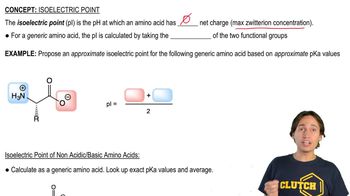
Isoelectric Point (pI)

The isoelectric point (pI) is the pH at which a molecule, such as an amino acid, carries no net electrical charge. For amino acids with multiple ionizable groups, the pI is calculated as the average of the pKa values of the groups that are protonated at that pH. This concept is crucial for understanding the behavior of amino acids in different pH environments.
Recommended video:
Guided course
03:19
Definition of Isoelectric Point

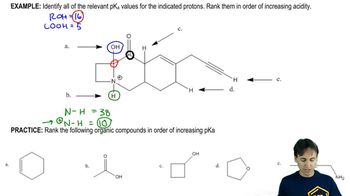
pKa Values

The pKa value is a measure of the acidity of a proton in a molecule, indicating the pH at which half of the species are deprotonated. In the case of lysine, which has two protonated amino groups, the pKa values reflect the strength of these groups in donating protons. Understanding pKa values is essential for predicting the ionization state of amino acids at various pH levels.
Recommended video:
Guided course
07:45
Identifying pKa values

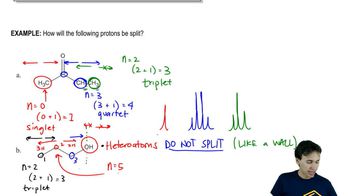
Protonation and Deprotonation

Protonation refers to the addition of a proton (H+) to a molecule, while deprotonation is the removal of a proton. In lysine, the two amino groups can be protonated, affecting the overall charge of the molecule. The balance between protonation and deprotonation at different pH levels determines the net charge of lysine, which is key to understanding its pI.
Recommended video:
Guided course
03:
Proton Splitting