


Carbonic anhydrase is an enzyme that catalyzes the conversion of carbon dioxide to bicarbonate ion. It is a metalloenzyme, with Zn2+ coordinated at the active site by three histidine side chains. Propose a mechanism for the reaction.
Bruice 8th Edition
Ch. 22 - Catalysis in Organic Reactions and in Enzymatic Reactions
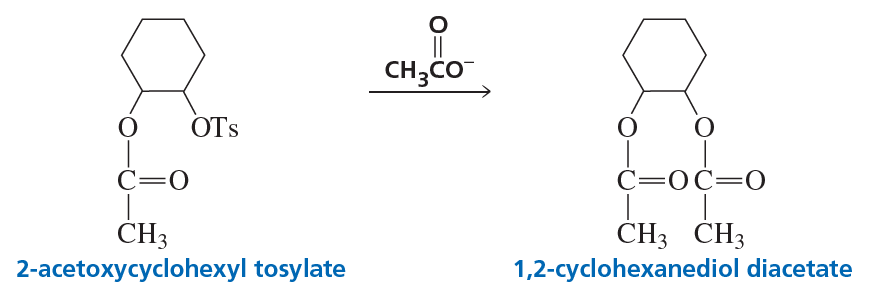
Problem 41c2-Acetoxycyclohexyl tosylate reacts with acetate ion to form 1,2-cyclohexanediol diacetate. The reaction is stereospecific—that is, the stereoisomers obtained as products depend on the stereoisomer used as a reactant. Recall that because 2-acetoxycyclohexyl tosylate has two asymmetric centers, it has four stereoisomers—two are cis and two are trans. Explain the following observations:
c. A trans reactant is more reactive than a cis reactant.

Verified step by step guidance
Verified video answer for a similar problem:
Key Concepts
Stereochemistry
Reactivity of Stereoisomers
Nucleophilic Substitution
2-Acetoxycyclohexyl tosylate reacts with acetate ion to form 1,2-cyclohexanediol diacetate. The reaction is stereospecific—that is, the stereoisomers obtained as products depend on the stereoisomer used as a reactant. Recall that because 2-acetoxycyclohexyl tosylate has two asymmetric centers, it has four stereoisomers—two are cis and two are trans. Explain the following observations:
b. Both trans reactants form the same racemic mixture.
3-Amino-2-oxindole catalyzes the decarboxylation of a-keto acids.
a. Propose a mechanism for the catalyzed reaction.
Proof that an imine was formed between aldolase and its substrate was obtained by using D-fructose-1,6-bisphosphate labeled at the C-2 position with 14C as the substrate. NaBH4 was added to the reaction mixture. A radioactive product was isolated from the reaction mixture and hydrolyzed in an acidic solution. Draw the structure of the radioactive product obtained from the acidic solution. (Hint: NaBH4 reduces an imine linkage.)
Explain why the alkyl halide shown here reacts much more rapidly with guanine than does a primary alkyl halide (such as pentyl chloride).
2-Acetoxycyclohexyl tosylate reacts with acetate ion to form 1,2-cyclohexanediol diacetate. The reaction is stereospecific—that is, the stereoisomers obtained as products depend on the stereoisomer used as a reactant. Recall that because 2-acetoxycyclohexyl tosylate has two asymmetric centers, it has four stereoisomers—two are cis and two are trans. Explain the following observations:
a. Both cis reactants form an optically active trans product, but each cis reactant forms a different trans product.