

Ch. 22 - Catalysis in Organic Reactions and in Enzymatic Reactions
Bruice - Organic Chemistry 8th Edition
Bruice8th EditionOrganic ChemistryISBN: 9780135213711Not the one you use?Change textbook
Chapter 23, Problem 41a

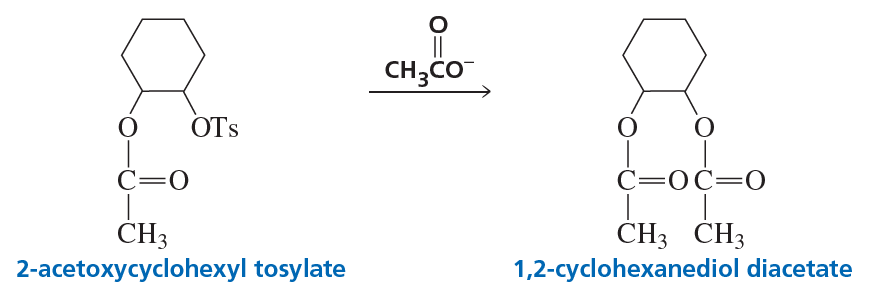
2-Acetoxycyclohexyl tosylate reacts with acetate ion to form 1,2-cyclohexanediol diacetate. The reaction is stereospecific—that is, the stereoisomers obtained as products depend on the stereoisomer used as a reactant. Recall that because 2-acetoxycyclohexyl tosylate has two asymmetric centers, it has four stereoisomers—two are cis and two are trans. Explain the following observations:
a. Both cis reactants form an optically active trans product, but each cis reactant forms a different trans product.
Chemical reaction diagram showing 2-acetoxycyclohexyl tosylate converting to 1,2-cyclohexanediol diacetate.

Verified step by step guidance
1
Step 1: Analyze the structure of 2-acetoxycyclohexyl tosylate. It contains two asymmetric centers, making it possible to have four stereoisomers: two cis and two trans. Cis stereoisomers have substituents on the same side of the cyclohexane ring, while trans stereoisomers have substituents on opposite sides.
Step 2: Understand the reaction mechanism. The acetate ion (CH₃CH₂CO⁻) acts as a nucleophile and performs an SN2 reaction on the tosylate group. SN2 reactions are stereospecific, meaning the configuration at the reacting carbon is inverted during the reaction.
Step 3: Consider the stereochemistry of the cis reactants. In the cis configuration, the acetoxy group and the tosylate group are on the same side of the cyclohexane ring. When the acetate ion attacks, it inverts the configuration at the carbon where the tosylate group is attached, leading to a trans product.
Step 4: Explain why each cis reactant forms a different trans product. The two cis reactants differ in the configuration of the second asymmetric center (the carbon with the acetoxy group). This difference is preserved during the reaction, resulting in two distinct trans products that are optically active.
Step 5: Highlight the stereospecificity of the reaction. The stereospecific nature of the SN2 mechanism ensures that the stereochemistry of the reactants directly determines the stereochemistry of the products. This explains why both cis reactants form trans products, but each forms a different one.

Verified video answer for a similar problem:

This video solution was recommended by our tutors as helpful for the problem above.
Video duration:
6m
Was this helpful?

Key Concepts

Here are the essential concepts you must grasp in order to answer the question correctly.

Stereochemistry

Stereochemistry is the study of the spatial arrangement of atoms in molecules and how this affects their chemical behavior. In this reaction, the stereochemistry of the reactants influences the stereochemistry of the products, leading to different stereoisomers. Understanding the concepts of cis and trans isomerism is crucial, as it helps explain why different cis reactants yield different trans products.
Recommended video:
1:38
Polymer Stereochemistry Concept 1

Stereospecific Reactions

Stereospecific reactions are those in which the configuration of the reactant determines the configuration of the product. In this case, the reaction of 2-acetoxycyclohexyl tosylate with acetate ion is stereospecific, meaning that the stereoisomer of the reactant directly influences the stereoisomer of the product formed. This concept is essential for understanding how different starting materials can lead to distinct outcomes.
Recommended video:
Guided course
05:09
Heck Reaction

Optical Activity

Optical activity refers to the ability of a chiral compound to rotate plane-polarized light. The formation of optically active products from the reaction indicates that the products have chiral centers. In this scenario, the trans products formed from the cis reactants are optically active due to their unique three-dimensional arrangements, which are a result of the stereospecific nature of the reaction.
Recommended video:
Guided course
08:17
Mutorotation and Optical Activity
Related Practice
Textbook Question

Carbonic anhydrase is an enzyme that catalyzes the conversion of carbon dioxide to bicarbonate ion. It is a metalloenzyme, with Zn2+ coordinated at the active site by three histidine side chains. Propose a mechanism for the reaction.

134
views
Textbook Question

2-Acetoxycyclohexyl tosylate reacts with acetate ion to form 1,2-cyclohexanediol diacetate. The reaction is stereospecific—that is, the stereoisomers obtained as products depend on the stereoisomer used as a reactant. Recall that because 2-acetoxycyclohexyl tosylate has two asymmetric centers, it has four stereoisomers—two are cis and two are trans. Explain the following observations:

b. Both trans reactants form the same racemic mixture.

1168
views
Textbook Question

Co2+ catalyzes the hydrolysis of the lactam shown here. Propose a mechanism for the metal-ion catalyzed reaction.

971
views
Textbook Question

2-Acetoxycyclohexyl tosylate reacts with acetate ion to form 1,2-cyclohexanediol diacetate. The reaction is stereospecific—that is, the stereoisomers obtained as products depend on the stereoisomer used as a reactant. Recall that because 2-acetoxycyclohexyl tosylate has two asymmetric centers, it has four stereoisomers—two are cis and two are trans. Explain the following observations:

c. A trans reactant is more reactive than a cis reactant.

1172
views
Textbook Question

Propose a mechanism for the following reaction. (Hint: The rate of the reaction is much slower if the nitrogen atom is replaced by CH.)

1136
views
Textbook Question

Proof that an imine was formed between aldolase and its substrate was obtained by using D-fructose-1,6-bisphosphate labeled at the C-2 position with 14C as the substrate. NaBH4 was added to the reaction mixture. A radioactive product was isolated from the reaction mixture and hydrolyzed in an acidic solution. Draw the structure of the radioactive product obtained from the acidic solution. (Hint: NaBH4 reduces an imine linkage.)

1320
views