
Carbonic anhydrase is an enzyme that catalyzes the conversion of carbon dioxide to bicarbonate ion. It is a metalloenzyme, with Zn2+ coordinated at the active site by three histidine side chains. Propose a mechanism for the reaction.
Ch. 22 - Catalysis in Organic Reactions and in Enzymatic Reactions
All textbooks
Bruice 8th Edition
Ch. 22 - Catalysis in Organic Reactions and in Enzymatic Reactions
Problem 34
Bruice 8th Edition
Ch. 22 - Catalysis in Organic Reactions and in Enzymatic Reactions
Problem 34Chapter 23, Problem 34
The rate constant for the uncatalyzed reaction of two molecules of glycine ethyl ester to form glycylglycine ethyl ester is 0.6 M-1 s-1. In the presence of Co2+, the rate constant is 1.5 × 10⁶ M-1 s-1. What rate enhancement does the catalyst provide?
Verified step by step guidance1
Understand the problem: The question asks for the rate enhancement provided by the catalyst. This is calculated by comparing the rate constant of the catalyzed reaction to the rate constant of the uncatalyzed reaction.
Identify the given values: The rate constant for the uncatalyzed reaction is k₁ = 0.6 M⁻¹s⁻¹, and the rate constant for the catalyzed reaction is k₂ = 1.5 × 10⁶ M⁻¹s⁻¹.
Set up the formula for rate enhancement: Rate enhancement is defined as the ratio of the catalyzed rate constant to the uncatalyzed rate constant. Mathematically, this is expressed as: .
Substitute the given values into the formula: Replace k₁ and k₂ with their respective values in the formula: .
Simplify the expression to find the rate enhancement: Perform the division to calculate the ratio, which will give the magnitude of the rate enhancement provided by the catalyst.

Verified video answer for a similar problem:
This video solution was recommended by our tutors as helpful for the problem above.
Video duration:
2mWas this helpful?
Key Concepts
Here are the essential concepts you must grasp in order to answer the question correctly.
Rate Constant
The rate constant (k) is a proportionality factor in the rate equation of a chemical reaction, indicating the speed at which reactants are converted to products. It is specific to a given reaction at a particular temperature and is influenced by factors such as concentration and the presence of catalysts. In this question, the rate constants for both the uncatalyzed and catalyzed reactions are provided, which are essential for calculating the rate enhancement.
Recommended video:
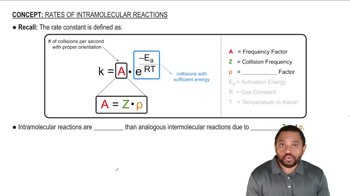
Rates of Intramolecular Reactions Concept 1
Catalysis
Catalysis is the process by which the rate of a chemical reaction is increased by the presence of a catalyst, which is a substance that is not consumed in the reaction. Catalysts work by providing an alternative reaction pathway with a lower activation energy, allowing the reaction to proceed more quickly. In this scenario, Co2+ acts as a catalyst, significantly increasing the rate constant from 0.6 M - 1s - 1 to 1.5 * 10^6 M - 1s - 1.
Recommended video:
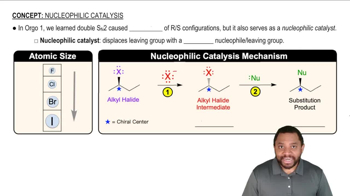
Nucleophilic Catalysis Concept 1
Rate Enhancement
Rate enhancement refers to the factor by which a catalyst increases the rate of a reaction compared to the uncatalyzed reaction. It is calculated by dividing the rate constant of the catalyzed reaction by that of the uncatalyzed reaction. In this case, the rate enhancement can be determined by taking the ratio of the two given rate constants, illustrating the effectiveness of the catalyst in accelerating the reaction.
Recommended video:
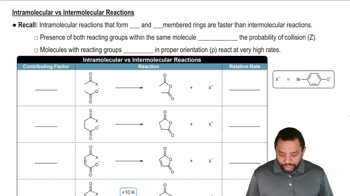
Rates of Intramolecular Reactions Concept 2
Related Practice
Textbook Question
134
views
Textbook Question
Co2+ catalyzes the hydrolysis of the lactam shown here. Propose a mechanism for the metal-ion catalyzed reaction.
971
views
Textbook Question
Propose a mechanism for the following reaction. (Hint: The rate of the reaction is much slower if the nitrogen atom is replaced by CH.)
1136
views
Textbook Question
The deuterium kinetic isotope effect (kH2O/kD2O) for the hydrolysis of aspirin is 2.2. What does this tell you about the kind of catalysis exerted by the ortho-carboxyl substituent? (Hint: It is easier to break an O–H bond than an O–D bond.)
74
views
Textbook Question
Indicate the type of catalysis that is occurring in the slow step in each of the following reaction sequences:
b.
725
views
Textbook Question
Indicate the type of catalysis that is occurring in the slow step in each of the following reaction sequences:
a.
840
views