


Ch. 22 - Catalysis in Organic Reactions and in Enzymatic Reactions
Bruice - Organic Chemistry 8th Edition
Bruice8th EditionOrganic ChemistryISBN: 9780135213711Not the one you use?Change textbook
Chapter 23, Problem 37

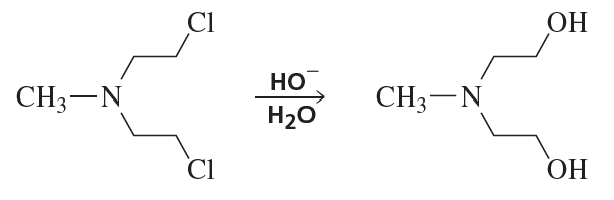
Propose a mechanism for the following reaction. (Hint: The rate of the reaction is much slower if the nitrogen atom is replaced by CH.)
Chemical reaction diagram showing a nitrogen atom substitution with hydroxyl groups, indicating a slower reaction rate with CH.

Verified step by step guidance
1
Step 1: Analyze the structure of the reactant. The molecule contains two bromine atoms attached to carbon atoms adjacent to a nitrogen atom. The nitrogen atom has a lone pair of electrons, making it nucleophilic and capable of stabilizing intermediates.
Step 2: Consider the role of hydroxide ion (OH⁻) as a strong nucleophile and base. The hydroxide ion will likely initiate the reaction by attacking one of the carbon atoms bonded to bromine, leading to the displacement of the bromine atom via an SN2 mechanism.
Step 3: The nitrogen atom plays a key role in stabilizing the intermediate formed after the bromine atom is displaced. Its lone pair can help stabilize the transition state, which explains why the reaction rate is slower when nitrogen is replaced by CH (carbon-hydrogen group).
Step 4: After the first bromine atom is displaced, the hydroxide ion can attack the second carbon-bromine bond in a similar SN2 mechanism. This results in the formation of the final product, where both bromine atoms are replaced by hydroxyl groups (-OH).
Step 5: The final product is a molecule with two hydroxyl groups attached to the carbon atoms adjacent to the nitrogen atom. The nitrogen atom remains unchanged, retaining its lone pair of electrons.

Verified video answer for a similar problem:

This video solution was recommended by our tutors as helpful for the problem above.
Video duration:
4m
Was this helpful?

Key Concepts

Here are the essential concepts you must grasp in order to answer the question correctly.

Nucleophilic Substitution

Nucleophilic substitution is a fundamental reaction in organic chemistry where a nucleophile attacks an electrophile, resulting in the replacement of a leaving group. In this case, the nitrogen atom acts as a nucleophile, attacking the carbon bonded to bromine, leading to the substitution of bromine with a hydroxyl group. Understanding this mechanism is crucial for predicting the outcome of the reaction.
Recommended video:
Guided course
01:47
Nucleophiles and Electrophiles can react in Substitution Reactions.

Leaving Groups

A leaving group is an atom or group that can depart from the parent molecule during a chemical reaction, facilitating the formation of a new bond. In the provided reaction, bromine is the leaving group, and its ability to leave is influenced by the nature of the atom it is attached to. The hint suggests that replacing nitrogen with a carbon atom significantly slows the reaction, indicating that nitrogen is a better leaving group than carbon.
Recommended video:
Guided course
07:22
The 3 important leaving groups to know.

Reaction Mechanism

A reaction mechanism is a step-by-step description of the process by which reactants are converted into products. It outlines the sequence of bond-breaking and bond-forming events, providing insight into the reaction's kinetics and thermodynamics. In this case, proposing a mechanism involves detailing how the nucleophilic attack occurs, the role of the leaving group, and the formation of the final product, which is essential for understanding the reaction's dynamics.
Recommended video:
Guided course
02:16
Heck Reaction Mechanism
Related Practice
Textbook Question

Carbonic anhydrase is an enzyme that catalyzes the conversion of carbon dioxide to bicarbonate ion. It is a metalloenzyme, with Zn2+ coordinated at the active site by three histidine side chains. Propose a mechanism for the reaction.

134
views
Textbook Question

2-Acetoxycyclohexyl tosylate reacts with acetate ion to form 1,2-cyclohexanediol diacetate. The reaction is stereospecific—that is, the stereoisomers obtained as products depend on the stereoisomer used as a reactant. Recall that because 2-acetoxycyclohexyl tosylate has two asymmetric centers, it has four stereoisomers—two are cis and two are trans. Explain the following observations:

b. Both trans reactants form the same racemic mixture.

1168
views
Textbook Question

Co2+ catalyzes the hydrolysis of the lactam shown here. Propose a mechanism for the metal-ion catalyzed reaction.

971
views
Textbook Question

The rate constant for the uncatalyzed reaction of two molecules of glycine ethyl ester to form glycylglycine ethyl ester is 0.6 M-1 s-1. In the presence of Co2+, the rate constant is 1.5 × 10⁶ M-1 s-1. What rate enhancement does the catalyst provide?

1058
views
Textbook Question

The deuterium kinetic isotope effect (kH2O/kD2O) for the hydrolysis of aspirin is 2.2. What does this tell you about the kind of catalysis exerted by the ortho-carboxyl substituent? (Hint: It is easier to break an O–H bond than an O–D bond.)

74
views
Textbook Question

2-Acetoxycyclohexyl tosylate reacts with acetate ion to form 1,2-cyclohexanediol diacetate. The reaction is stereospecific—that is, the stereoisomers obtained as products depend on the stereoisomer used as a reactant. Recall that because 2-acetoxycyclohexyl tosylate has two asymmetric centers, it has four stereoisomers—two are cis and two are trans. Explain the following observations:

a. Both cis reactants form an optically active trans product, but each cis reactant forms a different trans product.

2114
views