Ch. 28 - Pericyclic Reactions
Bruice - Organic Chemistry 8th Edition
Bruice8th EditionOrganic ChemistryISBN: 9780135213711Not the one you use?Change textbook
Chapter 25, Problem 9

Compare the reaction between 2,4,6-cycloheptatrienone and cyclopentadiene to the reaction between 2,4,6-cycloheptatrienone and ethene. Why does 2,4,6-cycloheptatrienone use two π\(\pi\) electrons in one reaction and four π\(\pi\) electrons in the other?
a.
b.

Verified step by step guidance
1
Step 1: Analyze the reaction between 2,4,6-cycloheptatrienone and cyclopentadiene. This reaction is a Diels-Alder reaction, where cyclopentadiene acts as the diene (providing four π electrons) and 2,4,6-cycloheptatrienone acts as the dienophile (providing two π electrons). The reaction forms a bicyclic compound with a new six-membered ring.
Step 2: Analyze the reaction between 2,4,6-cycloheptatrienone and ethene. This reaction is a [2+2] cycloaddition, where ethene provides two π electrons and 2,4,6-cycloheptatrienone also contributes two π electrons. The reaction forms a four-membered ring fused to the cycloheptatrienone structure.
Step 3: Understand why 2,4,6-cycloheptatrienone uses different numbers of π electrons in these reactions. In the Diels-Alder reaction, the conjugated π system of cyclopentadiene interacts with the π system of 2,4,6-cycloheptatrienone, allowing the use of four π electrons from the diene and two π electrons from the dienophile. In the [2+2] cycloaddition with ethene, only two π electrons from each reactant are involved.
Step 4: Consider the electronic structure of 2,4,6-cycloheptatrienone. The molecule has a conjugated π system, but its reactivity depends on the type of reaction and the nature of the other reactant. In the Diels-Alder reaction, the extended conjugation of cyclopentadiene matches the π system of 2,4,6-cycloheptatrienone, while in the [2+2] cycloaddition, ethene's simpler π system limits the interaction to two π electrons.
Step 5: Summarize the key difference. The number of π electrons used by 2,4,6-cycloheptatrienone depends on the type of cycloaddition reaction and the electronic compatibility of the reactants. The Diels-Alder reaction involves a [4+2] interaction, while the [2+2] cycloaddition involves a simpler interaction between two π electrons from each reactant.

Verified video answer for a similar problem:

This video solution was recommended by our tutors as helpful for the problem above.
Video duration:
3m
Was this helpful?

Key Concepts

Here are the essential concepts you must grasp in order to answer the question correctly.

Diels-Alder Reaction

The Diels-Alder reaction is a [4+2] cycloaddition reaction between a conjugated diene and a dienophile, resulting in the formation of a six-membered ring. In this context, cyclopentadiene acts as the diene, while 2,4,6-cycloheptatrienone serves as the dienophile. This reaction is significant for understanding how p electrons are utilized in forming new bonds during the reaction.
Recommended video:
Guided course
04:02
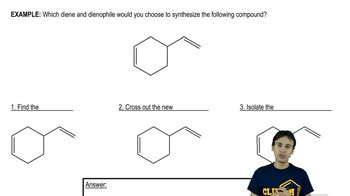
Diels-Alder Retrosynthesis

Electrophilicity and Nucleophilicity

Electrophilicity refers to the ability of a species to accept electrons, while nucleophilicity is the ability to donate electrons. In the reactions mentioned, 2,4,6-cycloheptatrienone acts as an electrophile when reacting with cyclopentadiene, which is a nucleophile. The difference in the number of p electrons used in each reaction can be attributed to the varying strengths of the electrophilic and nucleophilic components.
Recommended video:
Guided course
03:
Nucleophile or Electrophile

Conjugation and Resonance

Conjugation involves the overlap of p orbitals across adjacent double bonds, leading to increased stability through resonance. In the case of 2,4,6-cycloheptatrienone, the presence of multiple double bonds allows for resonance stabilization, which influences how many p electrons are involved in different reactions. This concept is crucial for understanding the reactivity patterns of the compounds in question.
Recommended video:
Guided course
05:29
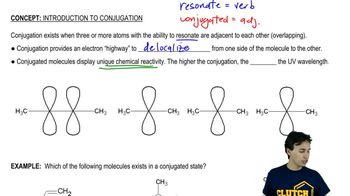
Definition of Conjugation