Ch. 28 - Pericyclic Reactions
Bruice - Organic Chemistry 8th Edition
Bruice8th EditionOrganic ChemistryISBN: 9780135213711Not the one you use?Change textbook
Chapter 25, Problem 10

Explain why maleic anhydride reacts rapidly with 1,3-butadiene but does not react at all with ethene under thermal conditions.
Chemical structure of maleic anhydride with the label "maleic anhydride" in blue text below the diagram.

Verified step by step guidance
1
Step 1: Recognize that maleic anhydride is a dienophile, meaning it readily participates in Diels-Alder reactions with conjugated dienes like 1,3-butadiene. The Diels-Alder reaction is a [4+2] cycloaddition reaction where a conjugated diene reacts with a dienophile to form a cyclic compound.
Step 2: Understand the structural requirements for the Diels-Alder reaction. Maleic anhydride has electron-withdrawing groups (carbonyl groups) that make it highly reactive as a dienophile. 1,3-butadiene, on the other hand, is a conjugated diene with alternating double bonds, which is necessary for the reaction to occur.
Step 3: Analyze why ethene does not react with maleic anhydride under thermal conditions. Ethene is not a conjugated diene; it only has one double bond. The Diels-Alder reaction requires a conjugated diene to provide the necessary orbital overlap and electron delocalization for the reaction to proceed.
Step 4: Consider the orbital interactions. In the Diels-Alder reaction, the HOMO (highest occupied molecular orbital) of the diene interacts with the LUMO (lowest unoccupied molecular orbital) of the dienophile. Ethene lacks the extended π-system of a conjugated diene, so it cannot provide the necessary orbital overlap with maleic anhydride.
Step 5: Conclude that the rapid reaction between maleic anhydride and 1,3-butadiene is due to the presence of a conjugated diene system in 1,3-butadiene, which facilitates the Diels-Alder reaction. Ethene, lacking this conjugation, cannot undergo the reaction under thermal conditions.

Verified video answer for a similar problem:

This video solution was recommended by our tutors as helpful for the problem above.
Video duration:
4m
Was this helpful?

Key Concepts

Here are the essential concepts you must grasp in order to answer the question correctly.

Diels-Alder Reaction

The Diels-Alder reaction is a cycloaddition reaction between a conjugated diene and a dienophile, forming a six-membered ring. In this case, 1,3-butadiene acts as the diene, while maleic anhydride serves as the dienophile. The reaction is favored due to the electron-withdrawing nature of maleic anhydride, which enhances its reactivity with the electron-rich diene.
Recommended video:
Guided course
04:02
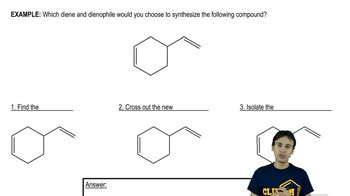
Diels-Alder Retrosynthesis

Electrophilicity

Electrophilicity refers to the tendency of a chemical species to accept electrons. Maleic anhydride is a highly electrophilic compound due to the presence of carbonyl groups, making it more reactive towards nucleophiles like 1,3-butadiene. In contrast, ethene is a less electrophilic alkene, which does not provide the same level of reactivity under thermal conditions.
Recommended video:
Guided course
03:
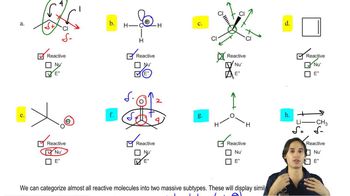
Nucleophile or Electrophile

Thermal Conditions

Thermal conditions refer to the influence of heat on chemical reactions. In the context of this question, the reaction between 1,3-butadiene and maleic anhydride is facilitated by heat, which provides the necessary energy to overcome the activation barrier. However, ethene's lack of reactivity under these conditions indicates that it does not participate in cycloaddition reactions, as it lacks the required diene structure and reactivity.
Recommended video:
Guided course
06:36
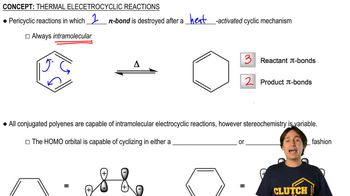
MO Theory of Thermal Electrocyclics