One of the chair conformers of cis-1,3-dimethylcyclohexane is 5.4 kcal/mol less stable than the other. How much steric strain does a 1,3-diaxial interaction between two methyl groups introduce into the conformer?
Ch. 3 - An Introduction to Organic Compounds:Nomenclature, Physical Properties, and Structure
All textbooks
Bruice 8th Edition
Ch. 3 - An Introduction to Organic Compounds:Nomenclature, Physical Properties, and Structure
Problem 84a
Bruice 8th Edition
Ch. 3 - An Introduction to Organic Compounds:Nomenclature, Physical Properties, and Structure
Problem 84aChapter 4, Problem 84a
Explain the following:
a. 1-Hexanol has a higher boiling point than 3-hexanol.
Verified step by step guidance1
Step 1: Understand the molecular structure of 1-hexanol and 3-hexanol. Both are alcohols with the molecular formula C6H14O, but the position of the hydroxyl (-OH) group differs. In 1-hexanol, the -OH group is attached to the first carbon, while in 3-hexanol, it is attached to the third carbon.
Step 2: Recall that boiling point is influenced by intermolecular forces. Alcohols exhibit hydrogen bonding due to the presence of the -OH group, which significantly increases their boiling points compared to hydrocarbons of similar molecular weight.
Step 3: Analyze the hydrogen bonding potential. In 1-hexanol, the -OH group is at the end of the molecule, allowing for more effective hydrogen bonding interactions with neighboring molecules. In contrast, in 3-hexanol, the -OH group is located in the middle of the molecule, which can slightly hinder the extent of hydrogen bonding due to steric effects.
Step 4: Consider the molecular shape and surface area. 1-Hexanol has a more linear structure, which allows for better packing and stronger van der Waals forces between molecules. 3-Hexanol, with the -OH group in a more central position, may have a slightly less efficient packing arrangement.
Step 5: Conclude that the combination of stronger hydrogen bonding and better molecular packing in 1-hexanol results in a higher boiling point compared to 3-hexanol.

Verified video answer for a similar problem:
This video solution was recommended by our tutors as helpful for the problem above.
Video duration:
4mWas this helpful?
Key Concepts
Here are the essential concepts you must grasp in order to answer the question correctly.
Boiling Point and Molecular Structure
The boiling point of a compound is influenced by its molecular structure, including factors like molecular weight and the presence of functional groups. In alcohols, hydrogen bonding plays a significant role; the more extensive the hydrogen bonding, the higher the boiling point. 1-Hexanol, with its primary alcohol structure, can form stronger hydrogen bonds compared to 3-hexanol, which is a secondary alcohol.
Recommended video:
Guided course
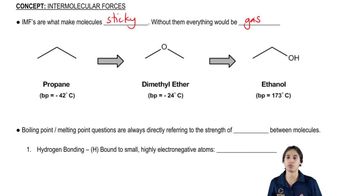
How IMFs are related to melting and boiling points.
Hydrogen Bonding
Hydrogen bonding occurs when a hydrogen atom covalently bonded to a highly electronegative atom, such as oxygen, interacts with another electronegative atom. This type of intermolecular force significantly affects the physical properties of alcohols, including boiling points. 1-Hexanol, having a more linear structure, allows for more effective hydrogen bonding compared to the branched structure of 3-hexanol.
Recommended video:
Guided course
The definition of hydrogenation.
Isomerism in Alcohols
Isomerism refers to compounds that have the same molecular formula but different structural arrangements. In the case of hexanol, 1-hexanol and 3-hexanol are structural isomers. The position of the hydroxyl (-OH) group affects the compound's ability to engage in hydrogen bonding and, consequently, its boiling point, with primary alcohols typically exhibiting higher boiling points than their secondary counterparts.
Recommended video:
Guided course
Monosaccharides - D and L Isomerism
Related Practice
Textbook Question
1417
views
Textbook Question
The most stable form of glucose (blood sugar) is a six-membered ring in a chair conformation with its five substituents all in equatorial positions. Draw the most stable conformer of glucose by putting the OH groups and hydrogens on the appropriate bonds in the structure on the right.
3128
views
1
rank
Textbook Question
Name the following compounds:
b.
1202
views
Textbook Question
What is each compound’s systematic name?
e.
f.
746
views
Textbook Question
Calculate the energy difference between the two chair conformers of trans-1,2-dimethylcyclohexane.
989
views
Textbook Question
Bromine is a larger atom than chlorine, but the equilibrium constants in Table 3.9 indicate that a chloro substituent has a greater preference for the equatorial position than does a bromo substituent. Suggest an explanation for this fact.
1632
views