One of the chair conformers of cis-1,3-dimethylcyclohexane is 5.4 kcal/mol less stable than the other. How much steric strain does a 1,3-diaxial interaction between two methyl groups introduce into the conformer?
Ch. 3 - An Introduction to Organic Compounds:Nomenclature, Physical Properties, and Structure
All textbooks
Bruice 8th Edition
Ch. 3 - An Introduction to Organic Compounds:Nomenclature, Physical Properties, and Structure
Problem 83e,f
Bruice 8th Edition
Ch. 3 - An Introduction to Organic Compounds:Nomenclature, Physical Properties, and Structure
Problem 83e,fChapter 4, Problem 83e,f
What is each compound’s systematic name?
e. 
f. 
Verified step by step guidance1
Step 1: Identify the longest continuous carbon chain in each compound. This will serve as the parent chain. For both compounds, the longest chain contains six carbons, making the parent name 'hexane'.
Step 2: Determine the functional groups attached to the parent chain. In the first compound, there are two hydroxyl (-OH) groups. In the second compound, there is one hydroxyl (-OH) group and one bromine (Br) atom.
Step 3: Number the carbon atoms in the parent chain to give the substituents the lowest possible numbers. For the first compound, number the chain so that the hydroxyl groups are on carbons 1 and 6. For the second compound, number the chain so that the hydroxyl group is on carbon 1 and the bromine atom is on carbon 6.
Step 4: Assign locants (numbers) and prefixes to the substituents. For the first compound, the locants for the hydroxyl groups are 1 and 6, and the prefix 'di-' is used to indicate two hydroxyl groups. For the second compound, the locants are 1 for the hydroxyl group and 6 for the bromine atom.
Step 5: Combine the locants, prefixes, and parent name to write the systematic name. For the first compound, the name is '1,6-hexanediol'. For the second compound, the name is '6-bromo-1-hexanol'.

Verified video answer for a similar problem:
This video solution was recommended by our tutors as helpful for the problem above.
Video duration:
3mWas this helpful?
Key Concepts
Here are the essential concepts you must grasp in order to answer the question correctly.
IUPAC Nomenclature
IUPAC nomenclature is a systematic method for naming organic chemical compounds. It provides a set of rules to create unique names based on the structure of the molecule, including the longest carbon chain, functional groups, and stereochemistry. Understanding these rules is essential for accurately identifying and communicating the identity of compounds.
Recommended video:
Guided course
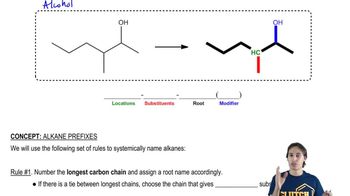
The different parts of an IUPAC name
Functional Groups
Functional groups are specific groups of atoms within molecules that are responsible for the characteristic chemical reactions of those molecules. Recognizing functional groups is crucial for determining the properties and reactivity of organic compounds, as they dictate how the compound will behave in chemical reactions and influence its systematic name.
Recommended video:
Guided course
Identifying Functional Groups
Structural Isomerism
Structural isomerism occurs when compounds have the same molecular formula but different structural arrangements of atoms. This concept is important in organic chemistry as it affects the naming and properties of compounds. Understanding the different types of isomers, such as chain isomers and position isomers, is vital for correctly identifying and naming compounds.
Recommended video:
Guided course
Monosaccharides - D and L Isomerism
Related Practice
Textbook Question
1417
views
Textbook Question
The most stable form of glucose (blood sugar) is a six-membered ring in a chair conformation with its five substituents all in equatorial positions. Draw the most stable conformer of glucose by putting the OH groups and hydrogens on the appropriate bonds in the structure on the right.
3128
views
1
rank
Textbook Question
Explain the following:
a. 1-Hexanol has a higher boiling point than 3-hexanol.
2232
views
Textbook Question
What is each compound’s systematic name?
e.
f.
1193
views
Textbook Question
Calculate the energy difference between the two chair conformers of trans-1,2-dimethylcyclohexane.
989
views
Textbook Question
Bromine is a larger atom than chlorine, but the equilibrium constants in Table 3.9 indicate that a chloro substituent has a greater preference for the equatorial position than does a bromo substituent. Suggest an explanation for this fact.
1632
views