Which of the following are optically active?
Ch. 4 - Isomers: The Arrangement of Atoms in Space
Chapter 5, Problem 77a,b
Which of the following has an achiral stereoisomer?
a. 2,3-dichlorobutane
b. 2,3-dichloropentane
Verified step by step guidance1
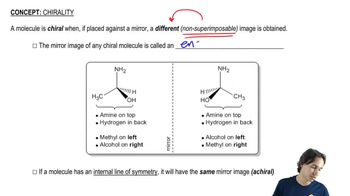
Step 1: Understand the concept of chirality. A molecule is chiral if it has a non-superimposable mirror image, typically due to the presence of a carbon atom bonded to four different groups. An achiral molecule, on the other hand, has a plane of symmetry or a center of symmetry, making it superimposable on its mirror image.
Step 2: Analyze the structure of 2,3-dichlorobutane. Draw the molecule and identify the stereocenters (chiral carbons). In this case, carbons 2 and 3 are stereocenters because they are bonded to four different groups.
Step 3: Determine if 2,3-dichlorobutane can have an achiral stereoisomer. Check for the possibility of a meso compound, which is an achiral molecule despite having stereocenters. A meso compound occurs when the molecule has an internal plane of symmetry that makes it superimposable on its mirror image.
Step 4: Repeat the analysis for 2,3-dichloropentane. Draw the molecule, identify the stereocenters (carbons 2 and 3), and check for the presence of an internal plane of symmetry that could result in a meso compound.
Step 5: Compare the findings for both molecules. Determine which molecule has an achiral stereoisomer (a meso form) based on the presence of an internal plane of symmetry. This will help you identify the correct answer.

Verified video answer for a similar problem:
This video solution was recommended by our tutors as helpful for the problem above.
Video duration:
4mWas this helpful?
Key Concepts
Here are the essential concepts you must grasp in order to answer the question correctly.
Chirality
Chirality refers to the geometric property of a molecule that makes it non-superimposable on its mirror image. A chiral molecule typically has at least one carbon atom bonded to four different substituents, resulting in two distinct enantiomers. Understanding chirality is crucial for identifying stereoisomers and their properties.
Recommended video:
Guided course
What is chirality?
Stereoisomers
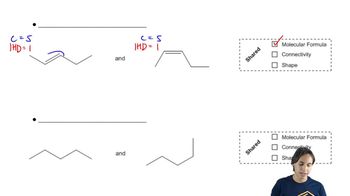
Stereoisomers are compounds that have the same molecular formula and connectivity of atoms but differ in the spatial arrangement of their atoms. This category includes enantiomers, which are non-superimposable mirror images, and diastereomers, which are not mirror images. Recognizing the types of stereoisomers is essential for determining the presence of achiral forms.
Recommended video:
Guided course
Determining when molecules are stereoisomers.
Achirality
Achirality describes molecules that are superimposable on their mirror images, meaning they do not exhibit chirality. A molecule can be achiral if it has a plane of symmetry or if it lacks chiral centers. Identifying achiral stereoisomers is important in organic chemistry, as it influences the reactivity and properties of the compounds.
Recommended video:
Guided course
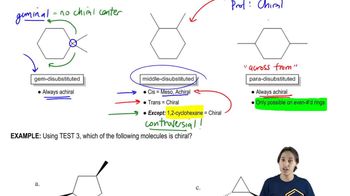
Cis-1,2-Disubstituted Cyclohexane:A controversial exception.
Related Practice
Textbook Question
2305
views
Textbook Question
Which of the following has an achiral stereoisomer?
e. 1,3-dibromocyclobutane
f. 2,4-dibromopentane
996
views
Textbook Question
Which of the following has an achiral stereoisomer?
i. 1,2-dimethylcyclopentane
j, 1,2-dimethylcyclobutane
1087
views
Textbook Question
For many centuries, the Chinese have used extracts from a group of herbs known as ephedra to treat asthma. A compound named ephedrine has been isolated from these herbs and found to be a potent dilator of air passages in the lungs.
a. How many stereoisomers does ephedrine have?
b. The stereoisomer shown here is the one that is pharmacologically active. What is the configuration of each of the asymmetric centers?
1370
views
Textbook Question
Are the following pairs identical, enantiomers, diastereomers, or constitutional isomers?
a.
b.
2992
views
1
rank
Textbook Question
Name the following:
c.
1424
views