
Ch. 4 - Isomers: The Arrangement of Atoms in Space
Bruice - Organic Chemistry 8th Edition
Bruice8th EditionOrganic ChemistryISBN: 9780135213711Not the one you use?Change textbook
Chapter 5, Problem 79a,b

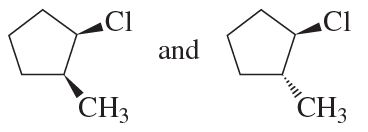
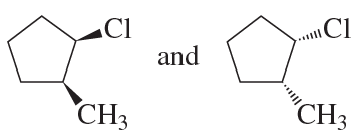
Are the following pairs identical, enantiomers, diastereomers, or constitutional isomers?
a. Two molecular structures are shown, labeled with Cl and CH3 groups, illustrating isomer relationships.
b. Two chemical structures are shown, labeled as "and," illustrating a comparison of isomers with chlorine and methyl groups.

Verified step by step guidance
1
Step 1: Analyze the structures in pair (a). Both molecules have the same connectivity of atoms, meaning they are not constitutional isomers. The hydroxyl group (OH) and bromine (Br) are attached to the same carbon atoms in both structures.
Step 2: Determine the stereochemistry of pair (a). The first molecule has both substituents (OH and Br) on wedges, indicating they are on the same side of the plane. The second molecule has OH on a wedge and Br on a dash, indicating they are on opposite sides of the plane. This difference in spatial arrangement suggests stereoisomerism.
Step 3: Check if pair (a) are enantiomers or diastereomers. Enantiomers are non-superimposable mirror images, while diastereomers are stereoisomers that are not mirror images. Since the two molecules in pair (a) are mirror images of each other, they are enantiomers.
Step 4: Analyze the structures in pair (b). Both molecules have the same connectivity of atoms, meaning they are not constitutional isomers. The hydroxyl group (OH) and bromine (Br) are attached to the same carbon atoms in both structures.
Step 5: Determine the stereochemistry of pair (b). The first molecule has OH on a wedge and Br on a dash, while the second molecule has OH on a dash and Br on a wedge. These are not mirror images of each other, indicating that they are diastereomers.

Verified video answer for a similar problem:

This video solution was recommended by our tutors as helpful for the problem above.
Video duration:
5m
Was this helpful?

Key Concepts

Here are the essential concepts you must grasp in order to answer the question correctly.

Stereoisomers

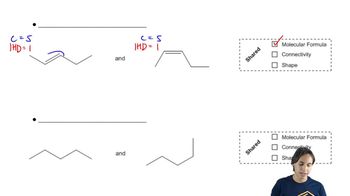
Stereoisomers are compounds that have the same molecular formula and connectivity of atoms but differ in the spatial arrangement of their atoms. This category includes enantiomers and diastereomers, which are crucial for understanding the chirality and optical activity of molecules. Enantiomers are non-superimposable mirror images, while diastereomers are not mirror images and have different physical properties.
Recommended video:
Guided course
01:58
Determining when molecules are stereoisomers.

Chirality

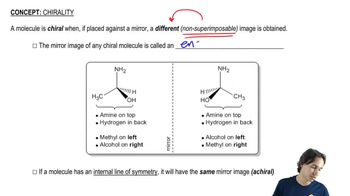
Chirality refers to the geometric property of a molecule that makes it non-superimposable on its mirror image. A chiral molecule typically has at least one carbon atom bonded to four different substituents, creating two distinct configurations known as enantiomers. Understanding chirality is essential for determining the relationship between isomers and their potential biological activity.
Recommended video:
Guided course
05:10
What is chirality?

Isomerism

Isomerism is the phenomenon where two or more compounds share the same molecular formula but differ in structure or arrangement. Isomers can be classified into constitutional isomers, which differ in the connectivity of atoms, and stereoisomers, which differ in spatial orientation. Recognizing the type of isomerism is vital for predicting the chemical behavior and reactivity of the compounds in question.
Recommended video:
Guided course
06:47
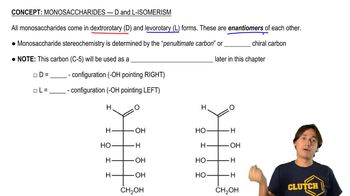
Monosaccharides - D and L Isomerism
Related Practice
Textbook Question

A solution of an unknown compound (3.0 g of the compound in 200 mL of solution), when placed in a polarimeter tube 2.0 dm long, was found to rotate the plane of polarized light 18° in a counterclockwise direction. What is the specific rotation of the compound?

1563
views
Textbook Question

Which of the following has an achiral stereoisomer?

e. 1,3-dibromocyclobutane

f. 2,4-dibromopentane

996
views
Textbook Question

Which of the following has an achiral stereoisomer?

i. 1,2-dimethylcyclopentane

j, 1,2-dimethylcyclobutane

1087
views
Textbook Question

Citrate synthase, one of the enzymes in the series of enzyme-catalyzed reactions known as the citric acid cycle, catalyzes the synthesis of citric acid from oxaloacetic acid and acetyl-CoA. If the synthesis is carried out with acetyl-CoA that contains radioactive carbon (14C) in the indicated position, the isomer shown here is obtained.

b. If the acetyl-CoA used in the synthesis contains 12C instead of 14C, will the product of the reaction be chiral or achiral?

1236
views
Textbook Question

Citrate synthase, one of the enzymes in the series of enzyme-catalyzed reactions known as the citric acid cycle, catalyzes the synthesis of citric acid from oxaloacetic acid and acetyl-CoA. If the synthesis is carried out with acetyl-CoA that contains radioactive carbon (14C) in the indicated position, the isomer shown here is obtained.

a. Which stereoisomer of citric acid is synthesized: R or S?

1616
views
Textbook Question

Which of the following has an achiral stereoisomer?

a. 2,3-dichlorobutane

b. 2,3-dichloropentane

1477
views
1
rank