Textbook Question
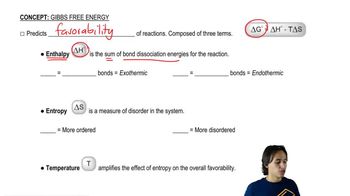
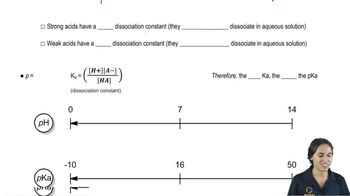
a. Which of the following reactions has the larger ∆S° value?
b. Is the ∆S° value positive or negative?
1095
views

 Bruice 8th EditionCh. 5 - Alkenes: Structure, Nomenclature, and an Introduction to Reactivity • Thermodynamics and KineticsProblem 61
 Verified step by step guidance
 05:02
05:02
 02:19
02:19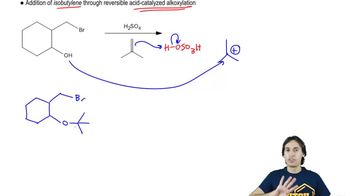 05:49
05:49a. Which of the following reactions has the larger ∆S° value?
b. Is the ∆S° value positive or negative?
Draw the structure of a compound with molecular C8H14 that reacts with one equivalent of H2 over Pd/C to form a meso compound
Given the reaction coordinate diagram for the reaction of A to form G, answer the following questions:
<IMAGE>
a. How many intermediates are formed in the reaction?
b. Which letters represent transition states?
c. What is the fastest step in the reaction?
d. Which is more stable: A or G?
e. Does A or E form faster from C?
f. Which is the more stable intermediate?
Given that the free energy of the twist-boat conformer of cyclohexane is 5.3 kcal/mol greater than that of the chair conformer, calculate the percentage of twist-boat conformers present in a sample of cyclohexane at 25 °C. Does your answer agree with the statement made in Section 3.13 about the relative number of molecules in these two conformations?
For a reaction carried out at 25 °C with an equilibrium constant of 1 × 10⁻³, to increase the equilibrium constant by a factor of 10:
a. how much must ∆G° change?
b. how much must ∆H° change if ∆S° = 0 kcal mol-1 K-1?
c. how much must ∆S° change if ∆H° = 0 kcal mol-1?
Using curved arrows, show the mechanism of the following reaction: