Ch. 5 - Alkenes: Structure, Nomenclature, and an Introduction to Reactivity • Thermodynamics and Kinetics
Bruice - Organic Chemistry 8th Edition
Bruice8th EditionOrganic ChemistryISBN: 9780135213711Not the one you use?Change textbook
Chapter 6, Problem 2a

What is the molecular formula for each of the following?
a. a 4-carbon hydrocarbon with two π\(\pi\) bonds and no rings

Verified step by step guidance
1
Step 1: Understand the problem. The question asks for the molecular formula of a 4-carbon hydrocarbon with two π bonds and no rings. Hydrocarbons are compounds made up of only carbon (C) and hydrogen (H).
Step 2: Recall the general formula for an acyclic (non-cyclic) hydrocarbon with π bonds. Each π bond corresponds to a double or triple bond, which reduces the number of hydrogens in the molecule. The general formula for an alkene (a hydrocarbon with one double bond) is CₙH₂ₙ, and for each additional π bond, two hydrogens are removed.
Step 3: Determine the degree of unsaturation. A 4-carbon hydrocarbon with two π bonds has two degrees of unsaturation. This means the molecule will have fewer hydrogens than a fully saturated alkane (C₄H₁₀).
Step 4: Apply the formula for a hydrocarbon with two π bonds. Start with the saturated formula for 4 carbons (C₄H₁₀) and subtract 4 hydrogens (2 hydrogens for each π bond). This gives the molecular formula.
Step 5: Verify the molecular formula by ensuring it satisfies the conditions of the problem: 4 carbons, 2 π bonds, and no rings. Double-check the hydrogen count to confirm the formula is correct.

Verified video answer for a similar problem:

This video solution was recommended by our tutors as helpful for the problem above.
Video duration:
3m
Was this helpful?

Key Concepts

Here are the essential concepts you must grasp in order to answer the question correctly.

Hydrocarbons

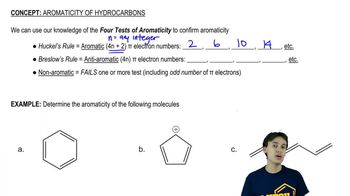
Hydrocarbons are organic compounds consisting entirely of hydrogen and carbon atoms. They can be classified into aliphatic (straight or branched chains) and aromatic (ring structures) categories. The simplest hydrocarbons are alkanes, alkenes, and alkynes, which differ in the types of bonds between carbon atoms—single, double, or triple bonds, respectively.
Recommended video:
Guided course
04:52
Aromaticity of Hydrocarbons

Molecular Formula

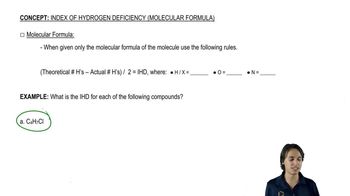
The molecular formula of a compound indicates the number and types of atoms present in a molecule. For hydrocarbons, it is expressed as CnHm, where 'n' is the number of carbon atoms and 'm' is the number of hydrogen atoms. Understanding how to derive the molecular formula from the structure is crucial for identifying the compound's properties and reactivity.
Recommended video:
Guided course
02:17
How to use IHD with molecular formula.

Unsaturation and Double Bonds

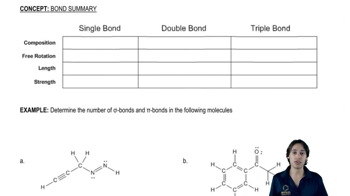
Unsaturation refers to the presence of double or triple bonds in a hydrocarbon, which affects its molecular formula and reactivity. Each double bond reduces the number of hydrogen atoms that can be attached to the carbon skeleton. In the case of a hydrocarbon with two double bonds, the formula can be derived by subtracting the appropriate number of hydrogen atoms from the saturated alkane formula, CnH2n+2.
Recommended video:
Guided course
06:00
Single bonds, double bonds, and triple bonds.