Ch. 5 - Alkenes: Structure, Nomenclature, and an Introduction to Reactivity • Thermodynamics and Kinetics
Bruice - Organic Chemistry 8th Edition
Bruice8th EditionOrganic ChemistryISBN: 9780135213711Not the one you use?Change textbook
Chapter 6, Problem 4c,d

Determine the degree of unsaturation for hydrocarbons with the following molecular formulas:
c. C12H20
d. C40H56

Verified step by step guidance
1
Step 1: Recall the formula for calculating the degree of unsaturation (also known as the index of hydrogen deficiency, IHD). The formula is: IHD = (2C + 2 - H)/2, where C is the number of carbon atoms, and H is the number of hydrogen atoms. This formula assumes the molecule contains only carbon and hydrogen.
Step 2: For part (c), substitute the values for C = 12 and H = 20 into the formula. Write the expression as: IHD = (2(12) + 2 - 20)/2.
Step 3: Simplify the expression for part (c) step by step. First, calculate the term 2(12), then add 2, subtract 20, and finally divide the result by 2 to determine the degree of unsaturation for C12H20.
Step 4: For part (d), substitute the values for C = 40 and H = 56 into the formula. Write the expression as: IHD = (2(40) + 2 - 56)/2.
Step 5: Simplify the expression for part (d) step by step. First, calculate the term 2(40), then add 2, subtract 56, and finally divide the result by 2 to determine the degree of unsaturation for C40H56.

Verified video answer for a similar problem:

This video solution was recommended by our tutors as helpful for the problem above.
Was this helpful?

Key Concepts

Here are the essential concepts you must grasp in order to answer the question correctly.

Degree of Unsaturation

The degree of unsaturation (DU) indicates the total number of rings and multiple bonds (double or triple) present in a hydrocarbon molecule. It can be calculated using the formula DU = (2C + 2 - H)/2, where C is the number of carbon atoms and H is the number of hydrogen atoms. A higher degree of unsaturation suggests more rings or multiple bonds, which affects the molecule's reactivity and stability.
Recommended video:
Guided course
02:39
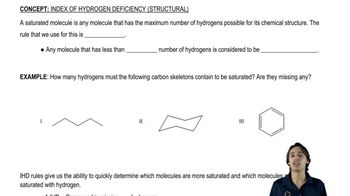
The difference between saturated and unsaturated molecules.

Hydrocarbon Structure

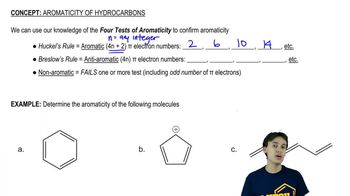
Hydrocarbons are organic compounds consisting solely of carbon (C) and hydrogen (H) atoms. They can be classified into aliphatic (alkanes, alkenes, alkynes) and aromatic compounds. Understanding the structure of hydrocarbons is essential for determining their properties, reactivity, and the implications of their degree of unsaturation.
Recommended video:
Guided course
04:52
Aromaticity of Hydrocarbons

Molecular Formula Interpretation

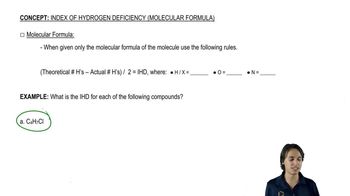
A molecular formula provides the number of each type of atom in a molecule, which is crucial for calculating the degree of unsaturation. For example, in the formulas C12H20 and C40H56, the number of carbon and hydrogen atoms directly influences the DU calculation. Interpreting these formulas correctly allows chemists to predict the presence of rings or multiple bonds in the compound.
Recommended video:
Guided course
02:17
How to use IHD with molecular formula.