

Ch. 6 - The Reactions of Alkenes • The Stereochemistry of Addition Reactions
Bruice - Organic Chemistry 8th Edition
Bruice8th EditionOrganic ChemistryISBN: 9780135213711Not the one you use?Change textbook
Chapter 7, Problem 70a(2)

Draw the product or products that will be obtained from the reaction of cis-2-butene and trans-2-butene with each of the following reagents. If a product can exist as stereoisomers, show which stereoisomers are formed.
2. BH3/THF, followed by HO-, H2O2, H2O

Verified step by step guidance
1
Step 1: Understand the reaction type. The reagents BH₃/THF followed by HO⁻, H₂O₂, and H₂O indicate a hydroboration-oxidation reaction. This reaction adds water (H and OH) across the double bond of an alkene in an anti-Markovnikov fashion, meaning the OH group will attach to the less substituted carbon of the double bond.
Step 2: Analyze the starting materials. Cis-2-butene and trans-2-butene are geometric isomers of 2-butene. Both have a double bond between carbons 2 and 3, but differ in the spatial arrangement of the substituents around the double bond. Cis-2-butene has both methyl groups on the same side, while trans-2-butene has them on opposite sides.
Step 3: Predict the regioselectivity. In hydroboration-oxidation, the OH group will attach to the less substituted carbon (C2 in this case), and the H will attach to the more substituted carbon (C3). This regioselectivity is consistent for both cis-2-butene and trans-2-butene.
Step 4: Consider the stereochemistry. Hydroboration-oxidation proceeds via a syn addition mechanism, meaning that the H and OH groups are added to the same face of the double bond. For cis-2-butene, this will result in a single product with both groups on the same side. For trans-2-butene, this will result in a different stereoisomer where the groups are also on the same side but start from opposite initial configurations.
Step 5: Draw the products. For cis-2-butene, the product will be a single stereoisomer of 2-butanol with syn addition. For trans-2-butene, the product will be the enantiomer of the product from cis-2-butene. Ensure to represent the stereochemistry clearly in your drawings, showing the OH and H groups on the same face for each product.

Verified video answer for a similar problem:

This video solution was recommended by our tutors as helpful for the problem above.
Video duration:
7m
Was this helpful?

Key Concepts

Here are the essential concepts you must grasp in order to answer the question correctly.

Alkene Reactivity

Alkenes are unsaturated hydrocarbons that contain a carbon-carbon double bond. Their reactivity is primarily due to this double bond, which can undergo various reactions such as hydroboration-oxidation. Understanding how alkenes react with different reagents is crucial for predicting the products formed in organic reactions.
Recommended video:
2:09
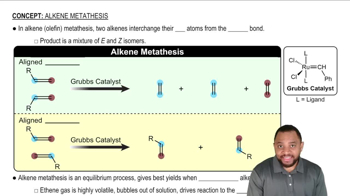
Alkene Metathesis Concept 1

Stereochemistry

Stereochemistry refers to the study of the spatial arrangement of atoms in molecules and how this affects their chemical behavior. In the context of alkenes, the configuration (cis or trans) can lead to different stereoisomers when reactions occur. Recognizing the potential for stereoisomer formation is essential for accurately depicting the products of reactions involving alkenes.
Recommended video:
1:38
Polymer Stereochemistry Concept 1

Hydroboration-Oxidation

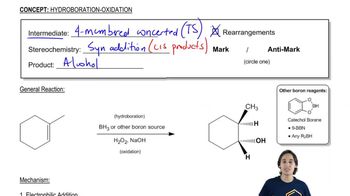
Hydroboration-oxidation is a two-step reaction process used to convert alkenes into alcohols. In the first step, BH3 adds across the double bond, resulting in a trialkylborane intermediate. The subsequent oxidation with hydrogen peroxide and hydroxide ion converts the boron to an alcohol, often leading to anti-Markovnikov addition, which is important for determining the final product's structure and stereochemistry.
Recommended video:
Guided course
06:38
General properties of hydroboration-oxidation.