

Ch. 6 - The Reactions of Alkenes • The Stereochemistry of Addition Reactions
Bruice - Organic Chemistry 8th Edition
Bruice8th EditionOrganic ChemistryISBN: 9780135213711Not the one you use?Change textbook
Chapter 7, Problem 70a(3)

Draw the product or products that will be obtained from the reaction of cis-2-butene and trans-2-butene with each of the following reagents. If a product can exist as stereoisomers, show which stereoisomers are formed.
3. a peroxyacid

Verified step by step guidance
1
Understand the reaction: The reaction of an alkene with a peroxyacid (RCO₃H) results in the formation of an epoxide. This is an electrophilic addition reaction where the π-bond of the alkene reacts with the peroxyacid to form a three-membered cyclic ether (epoxide).
Analyze the starting materials: cis-2-butene and trans-2-butene are geometric isomers of 2-butene. Cis-2-butene has both methyl groups on the same side of the double bond, while trans-2-butene has the methyl groups on opposite sides of the double bond.
Predict the stereochemistry of the products: The stereochemistry of the starting alkene determines the stereochemistry of the epoxide. For cis-2-butene, the epoxide will be a cis-epoxide (both substituents on the same side of the ring). For trans-2-butene, the epoxide will be a trans-epoxide (substituents on opposite sides of the ring).
Draw the products: For cis-2-butene, draw a three-membered epoxide ring with both methyl groups on the same side. For trans-2-butene, draw a three-membered epoxide ring with the methyl groups on opposite sides. Ensure the stereochemistry is clearly indicated using wedge and dash bonds.
Verify stereoisomers: Since the products are epoxides, they can exist as stereoisomers. For cis-2-butene, the product will be a single stereoisomer (cis-epoxide). For trans-2-butene, the product will also be a single stereoisomer (trans-epoxide).

Verified video answer for a similar problem:

This video solution was recommended by our tutors as helpful for the problem above.
Video duration:
6m
Was this helpful?

Key Concepts

Here are the essential concepts you must grasp in order to answer the question correctly.

Alkenes and Stereochemistry

Alkenes are hydrocarbons that contain at least one carbon-carbon double bond. The stereochemistry of alkenes, such as cis and trans isomers, is crucial in determining the products of reactions. In this case, cis-2-butene has substituents on the same side of the double bond, while trans-2-butene has them on opposite sides, leading to different reactivity and product formation.
Recommended video:
1:38
Polymer Stereochemistry Concept 1

Peroxyacid Reactions

Peroxyacids, such as m-chloroperbenzoic acid (MCPBA), are strong oxidizing agents that can react with alkenes to form epoxides. This reaction involves the addition of an oxygen atom across the double bond, resulting in a three-membered cyclic ether. Understanding this mechanism is essential for predicting the products formed from the reaction of alkenes with peroxyacids.
Recommended video:
Guided course
05:09
Heck Reaction

Stereoisomerism in Epoxides

Epoxides can exhibit stereoisomerism due to the presence of chiral centers formed during their synthesis. When alkenes like cis-2-butene and trans-2-butene react with a peroxyacid, the resulting epoxide can exist in different stereoisomeric forms. It is important to identify and represent these stereoisomers to fully describe the products of the reaction.
Recommended video:
Guided course
02:19
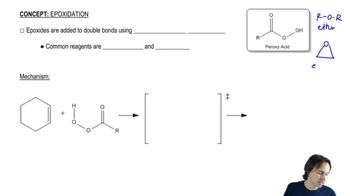
General properties of epoxidation.
Related Practice
Textbook Question

Draw the product or products that will be obtained from the reaction of cis-2-butene and trans-2-butene with each of the following reagents. If a product can exist as stereoisomers, show which stereoisomers are formed.

4. Br2 in CH2Cl2

687
views
Textbook Question

Draw the product or products that will be obtained from the reaction of cis-2-butene and trans-2-butene with each of the following reagents. If a product can exist as stereoisomers, show which stereoisomers are formed.

1. HCl

857
views
Textbook Question

a. Draw the product or products that will be obtained from the reaction of cis-2-butene and trans-2-butene with each of the following reagents. If a product can exist as stereoisomers, show which stereoisomers are formed.

7. H2O + H2SO4

b. With which reagents do the two alkenes react to form different products?

1315
views
Textbook Question

Draw the product or products that will be obtained from the reaction of cis-2-butene and trans-2-butene with each of the following reagents. If a product can exist as stereoisomers, show which stereoisomers are formed.

2. BH3/THF, followed by HO-, H2O2, H2O

1262
views
Textbook Question

The second-order rate constant (in units of M-1s-1) for acid-catalyzed hydration at 25 °C is given for each of the following alkenes:

a. Calculate the relative rates of hydration of the alkenes. (Hint: Divide each rate constant by the smallest rate constant of the series: 3.51 × 10⁻⁸.)

b. Why does (Z)-2-butene react faster than (E)-2-butene?

c. Why does 2-methyl-2-butene react faster than (Z)-2-butene?

d. Why does 2,3-dimethyl-2-butene react faster than 2-methyl-2-butene?

1621
views
Textbook Question

1-Methylcyclohexene forms two products when it reacts with bromine in methanol.

a. Draw the mechanism for the formation of the products.

b. Describe their stereochemical relationship—that is, are they enantiomers or diastereomers?

2019
views