Ch. 6 - The Reactions of Alkenes • The Stereochemistry of Addition Reactions
Bruice - Organic Chemistry 8th Edition
Bruice8th EditionOrganic ChemistryISBN: 9780135213711Not the one you use?Change textbook
Chapter 7, Problem 24

What is the product of the addition of I—Cl to 1-butene? (Hint: Chlorine is more electronegative than iodine [Table 1.3].)

Verified step by step guidance
1
Step 1: Analyze the structure of 1-butene. It is an alkene with the molecular formula C4H8, containing a double bond between the first and second carbon atoms.
Step 2: Understand the addition of I-Cl to the double bond. This reaction is an electrophilic addition, where the more electronegative atom (Cl) will act as the nucleophile and the less electronegative atom (I) will act as the electrophile.
Step 3: Refer to the electronegativity values in the provided table. Chlorine has an electronegativity of 3.0, while iodine has an electronegativity of 2.5. This confirms that chlorine is more electronegative than iodine.
Step 4: During the reaction, the π electrons of the double bond attack the iodine atom (the electrophile), forming a carbocation intermediate. Chlorine then attaches to the carbocation, completing the addition reaction.
Step 5: The product of the reaction will be a halogenated alkane, where iodine is attached to the first carbon and chlorine is attached to the second carbon of the original double bond.

Verified video answer for a similar problem:

This video solution was recommended by our tutors as helpful for the problem above.
Video duration:
5m
Was this helpful?

Key Concepts

Here are the essential concepts you must grasp in order to answer the question correctly.

Electrophilic Addition

Electrophilic addition is a fundamental reaction mechanism in organic chemistry where an electrophile reacts with a nucleophile, typically involving alkenes. In this process, the double bond of the alkene acts as a nucleophile, attacking the electrophile, leading to the formation of a more stable product. Understanding this mechanism is crucial for predicting the products of reactions involving alkenes.
Recommended video:
Guided course
09:23
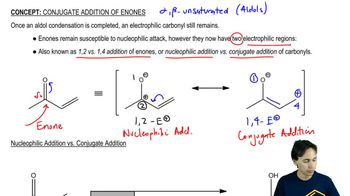
1,2 vs 1,4 Addition

Regioselectivity

Regioselectivity refers to the preference of a chemical reaction to yield one structural isomer over others when multiple products are possible. In the case of the addition of I—Cl to 1-butene, the regioselectivity is influenced by the relative electronegativities of chlorine and iodine, which affects how the addition occurs across the double bond. This concept is essential for determining the major product in addition reactions.
Recommended video:
Guided course
05:09
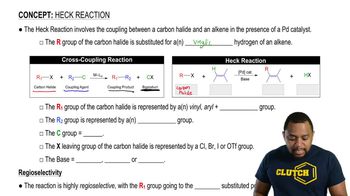
Heck Reaction

Electronegativity

Electronegativity is a measure of an atom's ability to attract and hold onto electrons in a chemical bond. In the context of the addition of I—Cl to 1-butene, chlorine's higher electronegativity compared to iodine means that chlorine will preferentially bond with the more electron-rich carbon atom of the alkene. This property is key to understanding the distribution of products formed during the reaction.
Recommended video:
Guided course
1:47
Electronegativity