Ch. 6 - The Reactions of Alkenes • The Stereochemistry of Addition Reactions
Bruice - Organic Chemistry 8th Edition
Bruice8th EditionOrganic ChemistryISBN: 9780135213711Not the one you use?Change textbook
Chapter 7, Problem 25a,b

What will be the major product obtained from the reaction of Br2 with 1-butene if the reaction is carried out in
a. dichloromethane?
b. water?

Verified step by step guidance
1
Identify the type of reaction occurring in each case. For part (a), the reaction of Br2 with 1-butene in dichloromethane is an electrophilic addition reaction in a non-polar solvent. For part (b), the reaction of Br2 with 1-butene in water involves a bromohydrin formation due to the presence of a polar protic solvent.
For part (a), in the presence of dichloromethane, the Br2 molecule acts as an electrophile. The π-electrons of the double bond in 1-butene attack the Br2 molecule, forming a cyclic bromonium ion intermediate.
Still in part (a), the bromonium ion is then attacked by a bromide ion (Br⁻) from the back side, leading to the anti-addition of bromine across the double bond. This results in the formation of 2,3-dibromobutane as the major product.
For part (b), in the presence of water, the reaction mechanism begins similarly with the formation of a bromonium ion intermediate. However, instead of a bromide ion attacking the intermediate, a water molecule (H2O) acts as the nucleophile due to its abundance in the reaction medium.
In part (b), the water molecule attacks the more substituted carbon of the bromonium ion (Markovnikov addition), leading to the formation of a bromohydrin. After deprotonation of the attached water molecule, the major product is 2-bromo-1-butanol.

Verified video answer for a similar problem:

This video solution was recommended by our tutors as helpful for the problem above.
Video duration:
6m
Was this helpful?

Key Concepts

Here are the essential concepts you must grasp in order to answer the question correctly.

Electrophilic Addition

Electrophilic addition is a fundamental reaction mechanism in organic chemistry where an electrophile reacts with a nucleophile, typically involving alkenes. In the case of 1-butene reacting with Br2, the double bond acts as a nucleophile, attacking the bromine molecule, leading to the formation of a bromonium ion intermediate. This process is crucial for understanding how alkenes react with halogens.
Recommended video:
Guided course
09:23
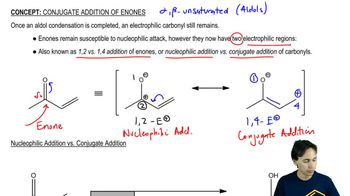
1,2 vs 1,4 Addition

Solvent Effects on Reaction Mechanisms

The choice of solvent can significantly influence the outcome of a chemical reaction. In non-polar solvents like dichloromethane, the reaction may favor the formation of a more stable product through a direct addition mechanism. Conversely, in polar solvents like water, the reaction can lead to different products due to the solvent's ability to stabilize charged intermediates, affecting the regioselectivity and stereochemistry of the final product.
Recommended video:
Guided course
02:26
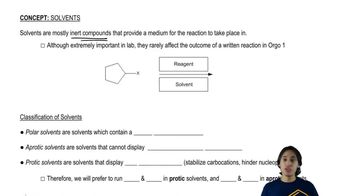
General format of reactions and how to interpret solvents.

Regioselectivity

Regioselectivity refers to the preference of a chemical reaction to yield one structural isomer over others when multiple possibilities exist. In the reaction of Br2 with 1-butene, the regioselectivity will depend on the solvent and the stability of the intermediates formed. For example, in water, the formation of a bromohydrin may occur, while in dichloromethane, a dibromide may be the major product, illustrating how regioselectivity is influenced by reaction conditions.
Recommended video:
Guided course
05:09
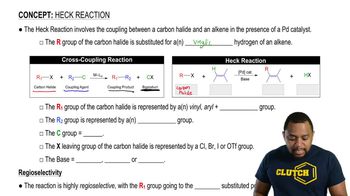
Heck Reaction